Learn what every symbol on the card means.Full credits and sources at beakbrain.com/symbols
 GrasslandScrapeHuge · 2.0 kg
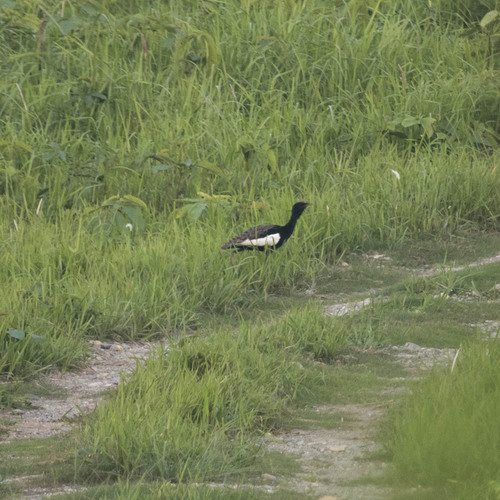
ID tip
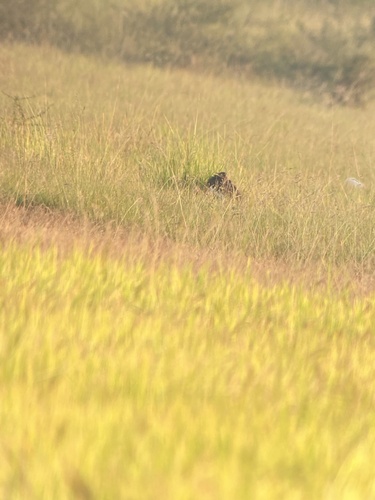
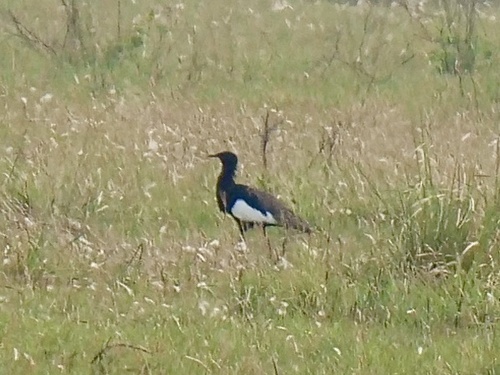
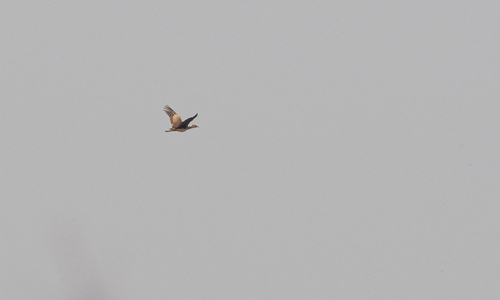
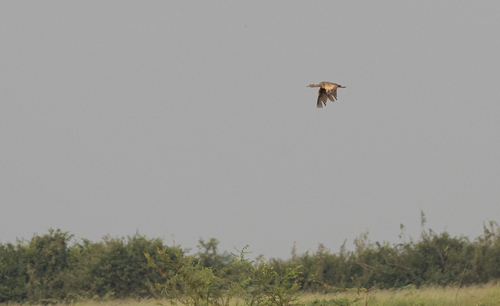
The male Bengal florican has a black plumage from the head and neck to underparts. Its head carries a long lanky crest, and the neck has elongated display plumes. The upperside is buff with fine black vermiculations and black arrowhead markings, and there is a conspicuous large white patch from the wing coverts to the remiges. In flight, the male's wings appear entirely white except for the dark primary remiges. The feet and legs are yellow, the bill and irides are dark.
Text from Wikipedia, licensed CC BY-SA 4.0.
When to see the Bengal Florican
One bar for each month. Filled bars are the 6 months with records; pale bars are months with none. The wide bar is March, the month with the most records.
Where to see the Bengal Florican
The map shades 3 countries with regular records. Everything unshaded has no records. Countries are listed below the map.
About the Bengal Florican
The Bengal florican, also called the Bengal bustard, is a bustard species native to the Indian subcontinent, Cambodia, and Vietnam. It is listed as Critically Endangered on the IUCN Red List because fewer than 1,000 individuals were estimated to be alive as of 2017. It is the only member of the genus Houbaropsis.
Text adapted from Wikipedia, licensed CC BY-SA 4.0.
Easily confused with
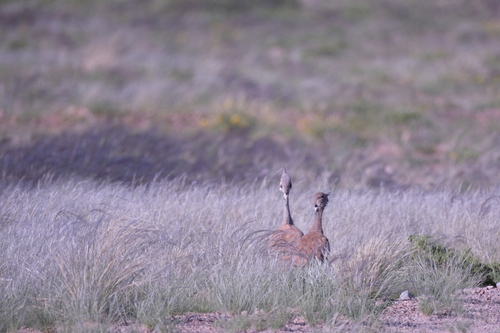 Rüppell's KorhaanHeterotetrax rueppeliiRüppell's korhaan is a small bustard, only 60 cm (24 in) long.
 Asian HoubaraChlamydotis macqueeniiThis medium-sized bustard is about 65 cm (26 in) long with a 140 cm (55 in) wingspan.
 Hartlaub's BustardLissotis hartlaubiiA mature Hartlaub's bustard is about 60 centimetres (24 in), recorded weights range from 1,500–1,600 g (3.3–3.5 lb).
Learn the Bengal Florican in the BeakBrain App
Photo and call practice. Coming soon to iPhone and Android.
Play today's Daily BirdEvery photo and recording on this page is credited to its author under the licence shown. Spotted a problem with this page, or have a better photo? Contribute.