Learn what every symbol on the card means.Full credits and sources at beakbrain.com/symbols
 GrasslandScrapeLarge · 1.2 kg

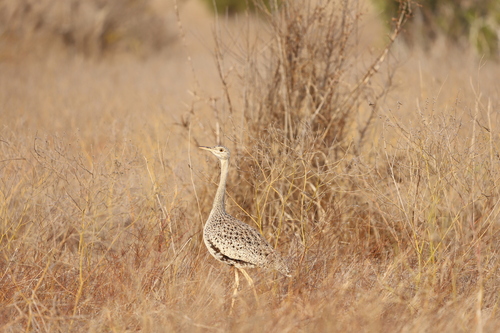
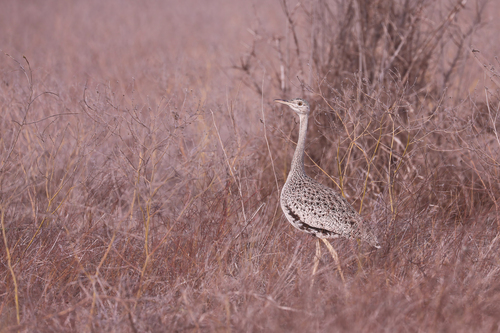
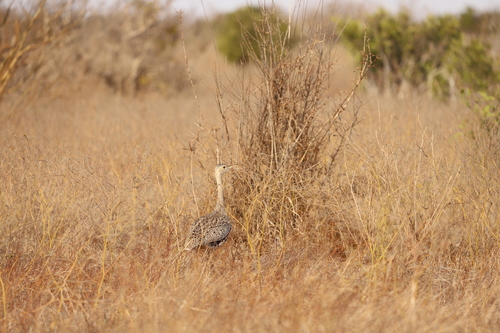
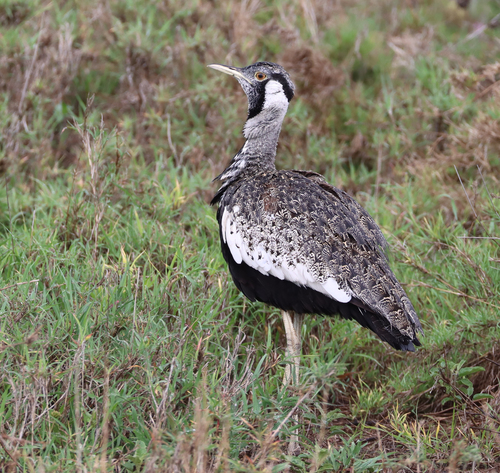
ID tip
A mature Hartlaub's bustard is about 60 centimetres (24 in), recorded weights range from 1,500–1,600 g (3.3–3.5 lb). They are indistinguishable from a far distance, as they are similar to L. melanogaster. The male Hartlaub's bustard has a grayish coloration with a more distinct black stripe on its face, as well as a black stripe running down its neck that connects to its black belly. They have a small head set on a long neck, and a bulky body with large legs. Voice: By inflating and extending its neck, the male Hartlaub's bustard produces three distinct sounds: a rapid "click", followed by a "tok", and then a long, deep "booom". These sounds do not travel far.
Text from Wikipedia, licensed CC BY-SA 4.0.
When to see the Hartlaub's Bustard
One bar for each month, and every month is filled: this bird is recorded here in all twelve. The wide bar is November, the month with the most records.
Where to see the Hartlaub's Bustard
The map shades 4 countries with regular records. Everything unshaded has no records. Countries are listed below the map.
About the Hartlaub's Bustard
Hartlaub's bustard is a species of bird in the family Otididae. It is a medium-sized bustard with a long, thick neck, and long legs. It is found in open, tall grassland, range from 1,600 to 2,000 metres in Ethiopia, Kenya, Somalia, Sudan, Tanzania, and Uganda.
Text adapted from Wikipedia, licensed CC BY-SA 4.0.
Easily confused with

Learn the Hartlaub's Bustard in the BeakBrain App
Photo and call practice. Coming soon to iPhone and Android.
Play today's Daily BirdEvery photo and recording on this page is credited to its author under the licence shown. Spotted a problem with this page, or have a better photo? Contribute.