Learn what every symbol on the card means.Full credits and sources at beakbrain.com/symbols
 DesertScrapeHuge · 1.5 kg
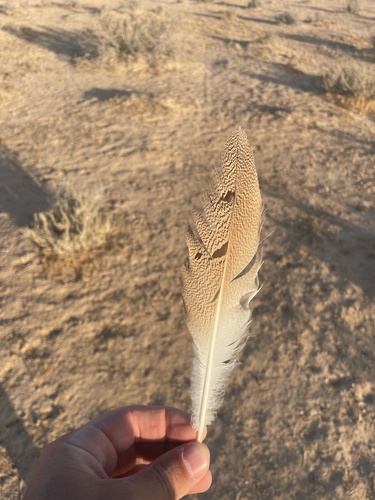
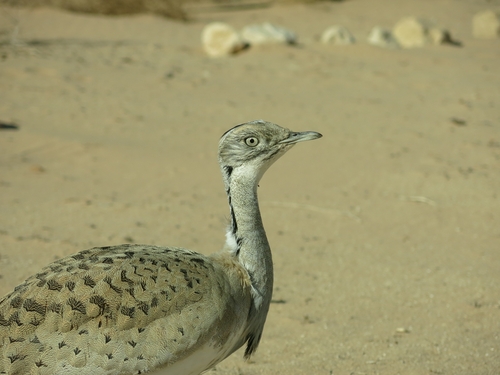

ID tip
This medium-sized bustard is about 65 cm (26 in) long with a 140 cm (55 in) wingspan. It is brown above and white below, with black stripes down the sides of the neck. In flight, the long wings show large areas of black and brown on the flight feathers and a white patch at the base of the primaries. From below the wing is mostly white with a black trailing edge. Sexes are similar, but the female is smaller and paler above. Males and females are nearly identical in plumage but males are slightly larger than females.
Text from Wikipedia, licensed CC BY-SA 4.0.
When to see the Asian Houbara
One bar for each month. Filled bars are the 9 months with records; pale bars are months with none. The wide bar is December, the month with the most records.
Where to see the Asian Houbara
The map shades 11 countries with regular records, and 5 more in a lighter tone where the bird turns up only as a stray. Everything unshaded has no records. Countries are listed below the map.
Recorded as a rare visitor in Sweden, Israel, Türkiye, Azerbaijan, Qatar.
About the Asian Houbara
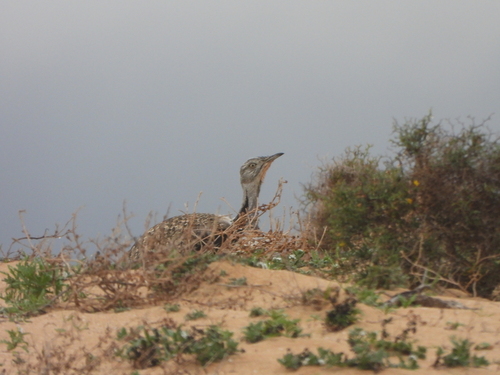
The Asian houbara, also known as MacQueen's bustard, is a large bird in the bustard family. It is native to the desert and steppe regions of Asia, east from the Sinai Peninsula extending across Iran and further north toward Kazakhstan and Mongolia. In the 19th century, vagrants were found as far west of their range as Great Britain. Populations have decreased by 20–50% between 1984 and 2004 mainly due to hunting and changes in land-use. The Asian houbara is a partial latitudinal migrant while the African houbara is more sedentary. These two species are the only members of the genus Chlamydotis. The Asian houbara used to be regarded as a subspecies of the African houbara.
Text adapted from Wikipedia, licensed CC BY-SA 4.0.
Easily confused with
Learn the Asian Houbara in the BeakBrain App
Photo and call practice. Coming soon to iPhone and Android.
Play today's Daily BirdEvery photo and recording on this page is credited to its author under the licence shown. Spotted a problem with this page, or have a better photo? Contribute.