Learn what every symbol on the card means.Full credits and sources at beakbrain.com/symbols
 DesertScrapeHuge · 1.5 kg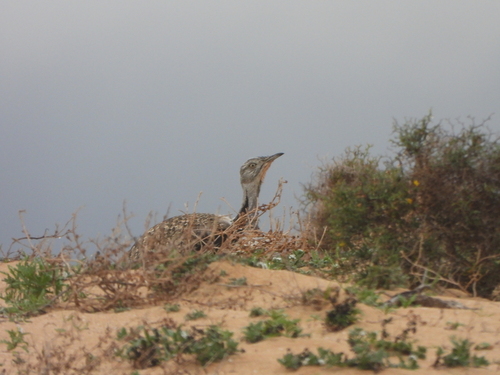


What the African Houbara sounds like

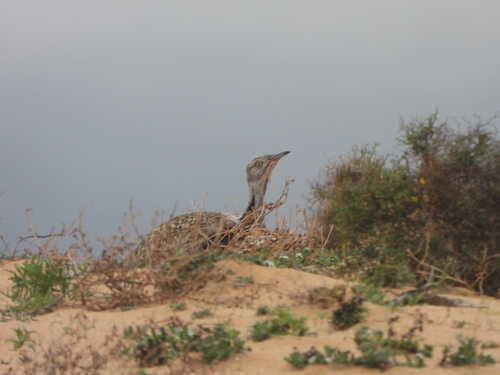
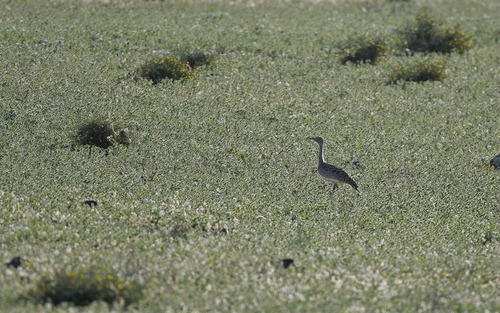
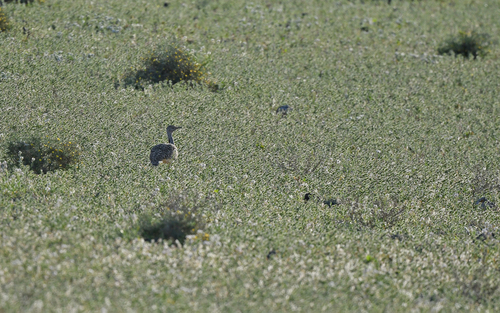
ID tip
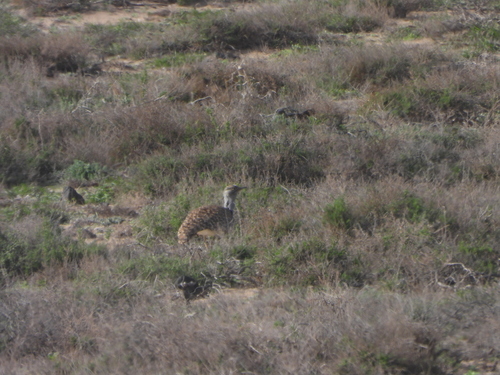
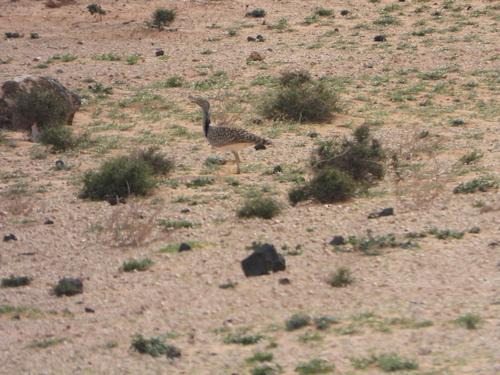
The African houbara is a small to mid-sized bustard. It measures 55–75 cm (22–30 in) in length and spans 135–170 cm (53–67 in) across the wings. It is brown above and white below, with a black stripe down the sides of its neck. In flight, the long wings show large areas of black and brown on the flight feathers. The sexes are similar, but the female, between 55–65 cm (22–26 in) tall, is rather smaller and greyer above than the male, at 65–75 cm (26–30 in) tall. The body mass is 1.8–3.2 kg (4.0–7.1 lb) in males and 1.2–1.7 kg (2.6–3.7 lb) in females.
Text from Wikipedia, licensed CC BY-SA 4.0.
When to see the African Houbara
One bar for each month. Filled bars are the 11 months with records; pale bars are months with none. The wide bar is February, the month with the most records.
Where to see the African Houbara
The map shades 3 countries with regular records. Everything unshaded has no records. Countries are listed below the map.
About the African Houbara
The African houbara, also known as the houbara bustard, is a relatively small bustard native to North Africa, where it lives in arid habitats. The global population is listed as Vulnerable on the IUCN Red List since 2014. There is a population in the Canary Islands which was assessed as Near Threatened in 2015, but has since also been assessed as Vulnerable.
Text adapted from Wikipedia, licensed CC BY-SA 4.0.
Easily confused with

Learn the African Houbara in the BeakBrain App
Photo and call practice. Coming soon to iPhone and Android.
Play today's Daily BirdEvery photo and recording on this page is credited to its author under the licence shown. Spotted a problem with this page, or have a better photo? Contribute.