Learn what every symbol on the card means.Full credits and sources at beakbrain.com/symbols
 ForestDomed nestSmall · 16 g
What the Barred Becard sounds like


ID tip
The barred becard is 12 to 13 cm (4.7 to 5.1 in) long and weighs 14 to 17 g (0.49 to 0.60 oz). It is the smallest member of genus Pachyramphus. Adult males of the nominate subspecies have a glossy black crown and nape and greenish yellow lores and eye-ring. Their face is also greenish yellow. Their upperparts are mostly glossy black with a slate gray rump and uppertail coverts. Their wings are black with white edges on the greater coverts and remiges. Their scapulars and lesser and median coverts are white with black edges. Their tail is slate gray with white edges on the feathers. Voice: The barred becard's song has been described as a "rising or rising-falling, accelerating series of thin, high whistles: wur wee WEE-WEE’WEE’WEE-WEE" and its calls as "thin, squeaky wsee notes in a chattered series".
Text from Wikipedia, licensed CC BY-SA 4.0.
When to see the Barred Becard
One bar for each month, and every month is filled: this bird is recorded here in all twelve. The wide bar is January, the month with the most records.
Where to see the Barred Becard
The map shades 7 countries with regular records. Everything unshaded has no records. Countries are listed below the map.
About the Barred Becard
The barred becard is a small passerine bird in the family Tityridae, the tityras, becards, and allies. It is found in Costa Rica, Panama, and in South America from Venezuela to Bolivia.
Text adapted from Wikipedia, licensed CC BY-SA 4.0.
Easily confused with
 Chestnut-crowned BecardPachyramphus castaneusThe chestnut-crowned becard is about 14 to 15 cm (5.5 to 5.9 in) long and weighs about 17 g (0.60 oz).
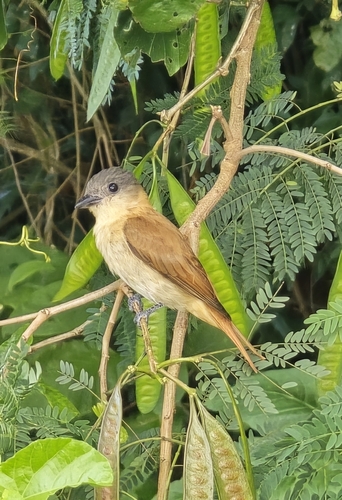 Crested BecardPachyramphus validusThe crested becard is 17 to 18.5 cm (6.7 to 7.3 in) long.
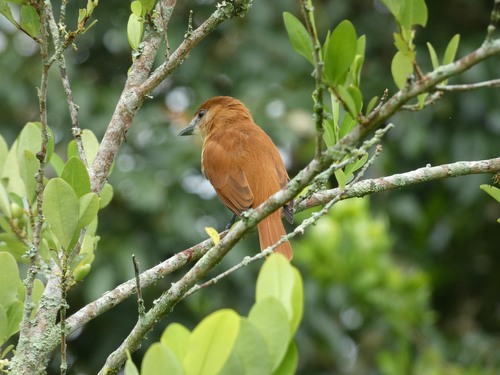 Cinereous BecardPachyramphus rufusThe cinereous becard is 12.9 to 14 cm (5.1 to 5.5 in) long and weighs about 18.5 g (0.65 oz).
Side by side: Barred Becard vs Rose-throated Becard · Barred Becard vs White-winged Becard · Barred Becard vs Cinnamon Becard · Barred Becard vs Chestnut-crowned Becard · Barred Becard vs Crested Becard · Barred Becard vs Cinereous Becard
Learn the Barred Becard in the BeakBrain App
Photo and call practice. Coming soon to iPhone and Android.
Play today's Daily BirdEvery photo and recording on this page is credited to its author under the licence shown. Spotted a problem with this page, or have a better photo? Contribute.