
Barred Becard
Pachyramphus versicolor
The barred becard is 12 to 13 cm (4.7 to 5.1 in) long and weighs 14 to 17 g (0.49 to 0.60 oz). It is the smallest member of genus Pachyramphus. Adult males of the nominate subspecies have a glossy black crown and nape and greenish yellow lores and eye-ring. Their face is also greenish yellow. Their upperparts are mostly glossy black with a slate gray rump and uppertail coverts. Their wings are black with white edges on the greater coverts and remiges. Their scapulars and lesser and median coverts are white with black edges. Their tail is slate gray with white edges on the feathers. Voice: The barred becard's song has been described as a "rising or rising-falling, accelerating series of thin, high whistles: wur wee WEE-WEE’WEE’WEE-WEE" and its calls as "thin, squeaky wsee notes in a chattered series".
ID text from Wikipedia, CC BY-SA 4.0

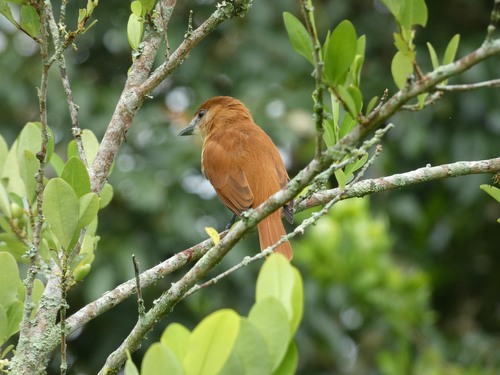
Cinereous Becard
Pachyramphus rufus
The cinereous becard is 12.9 to 14 cm (5.1 to 5.5 in) long and weighs about 18.5 g (0.65 oz). Adult males of the nominate subspecies have a glossy black crown, a white forehead and lores, a dusky spot in front of the eye, and pearl-gray cheeks. Their upperparts are mostly pearl-gray and sometimes have a faint olive tinge on the upper back. Their wings are blackish with thin white edges on the outer flight feathers and wider white edges on the inner flight feathers and coverts. Their tail is slaty gray; the feathers sometimes have whitish edges at their tips. Voice: "Both sexes appear to have rather large repertoire of melancholy songs". They typically are "a fast series of musical notes, e.g. twee, twee, twee-twee-twee-tweetweeteeteetititi, rising in pitch and accelerating to almost a trill".
ID text from Wikipedia, CC BY-SA 4.0
Where you might meet both
Learn this pair in the BeakBrain App
Photo and call practice. Coming soon to iPhone and Android.
Play today's Daily BirdPhotos and recordings are credited to their authors under the licence shown. Full profiles: Barred Becard and Cinereous Becard.