Learn what every symbol on the card means.Full credits and sources at beakbrain.com/symbols
 ForestCavity nestSmall · 47 g


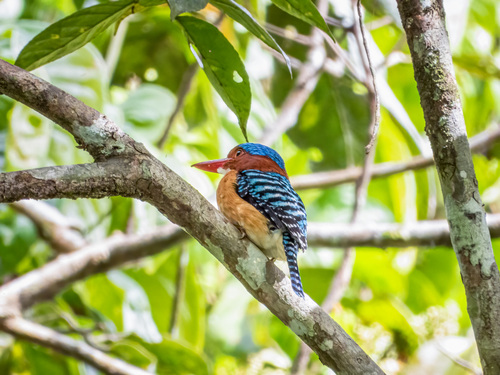


ID tip
The banded kingfisher is 20 cm (7.9 in) long with a sturdy red bill and a short crest which is slowly raised and lowered. It shows striking sexual dimorphism compared to most of its relatives. The adult male has a chestnut forehead, cheeks and nape, and a bright blue cap. The rest of the upperparts, wings and tail are black with blue bands. The breast, flanks and undertail are rufous, and the central belly is white. The adult female is equally striking, with black-and-rufous-banded upperparts, and white underparts with some black bars on the chest and flanks.
Text from Wikipedia, licensed CC BY-SA 4.0.
When to see the Banded Kingfisher
One bar for each month, and every month is filled: this bird is recorded here in all twelve. The wide bar is March, the month with the most records.
Where to see the Banded Kingfisher
The map shades 8 countries with regular records. Everything unshaded has no records. Countries are listed below the map.
About the Banded Kingfisher
The banded kingfisher is a tree kingfisher found in lowland tropical forests of southeast Asia. It is the only member of the genus Lacedo. Male and female adults are very different in plumage. The male has a bright blue crown with black and blue banding on the back. The female has rufous and black banding on the head and upperparts.
Text adapted from Wikipedia, licensed CC BY-SA 4.0.
Easily confused with
 Half-collared KingfisherAlcedo semitorquataThe half-collared kingfisher is a medium-sized kingfisher.
 Ruddy KingfisherHalcyon coromandaReaching approximately 25 cm, the ruddy kingfisher has a very large, bright red bill and equally red legs.
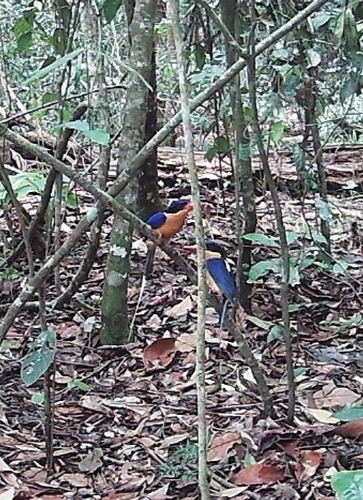 Buff-breasted Paradise KingfisherTanysiptera sylviaLike all paradise kingfishers, the buff-breasted is brightly coloured with a large red bill, rich rufous-buff underparts, blue or purple cap, crown and outer tail feathers, black eye stripes running down to the nape of its neck, red feet, white lower back and rump and long white or blue-and-white tail-feathers which varies geographically.
Side by side: Banded Kingfisher vs Half-collared Kingfisher · Banded Kingfisher vs Ruddy Kingfisher · Banded Kingfisher vs Buff-breasted Paradise Kingfisher
Learn the Banded Kingfisher in the BeakBrain App
Photo and call practice. Coming soon to iPhone and Android.
Play today's Daily BirdEvery photo and recording on this page is credited to its author under the licence shown. Spotted a problem with this page, or have a better photo? Contribute.