Learn what every symbol on the card means.Full credits and sources at beakbrain.com/symbols
 ForestCavity nestMedium · 78 g


ID tip
Reaching approximately 25 cm, the ruddy kingfisher has a very large, bright red bill and equally red legs. The body is rust red, generally deepening to purple at the tail. There is little sexual dimorphism though some sources report male birds being somewhat brighter in plumage. Due to its preference for heavily forested areas, the kingfisher's high, descending call is more often heard than the bird itself is seen, and these birds generally travel singly or in pairs.
Text from Wikipedia, licensed CC BY-SA 4.0.
When to see the Ruddy Kingfisher
One bar for each month. Filled bars are the 11 months with records; pale bars are months with none. The wide bar is May, the month with the most records.
Where to see the Ruddy Kingfisher
The map shades 17 countries with regular records, and 2 more in a lighter tone where the bird turns up only as a stray. Everything unshaded has no records. Countries are listed below the map.
About the Ruddy Kingfisher
The ruddy kingfisher is a medium-sized tree kingfisher, widely distributed in east and southeast Asia.
Text adapted from Wikipedia, licensed CC BY-SA 4.0.
Easily confused with
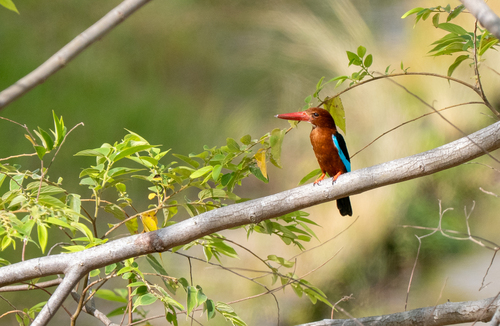 Brown-breasted KingfisherHalcyon gularisThe brown-breasted kingfisher is a tree kingfisher endemic to the Philippines, where it is widely distributed.
 Blue-breasted KingfisherHalcyon malimbicaThe blue-breasted kingfisher is a tree kingfisher widely distributed across Equatorial Africa.
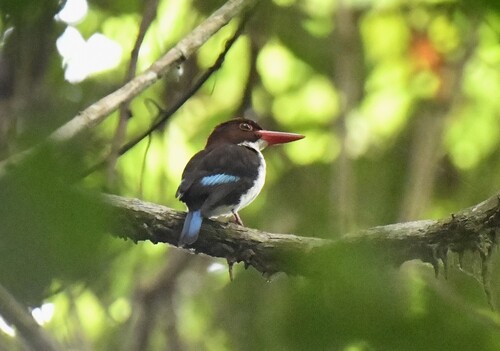 Chocolate-backed KingfisherHalcyon badiaThe chocolate-backed kingfisher has the typical stocky kingfisher shape with dark upper parts and pure white underparts.
Side by side: Black-capped Kingfisher vs Ruddy Kingfisher · Banded Kingfisher vs Ruddy Kingfisher
Learn the Ruddy Kingfisher in the BeakBrain App
Photo and call practice. Coming soon to iPhone and Android.
Play today's Daily BirdEvery photo and recording on this page is credited to its author under the licence shown. Spotted a problem with this page, or have a better photo? Contribute.