
Banded Kingfisher
Lacedo pulchella
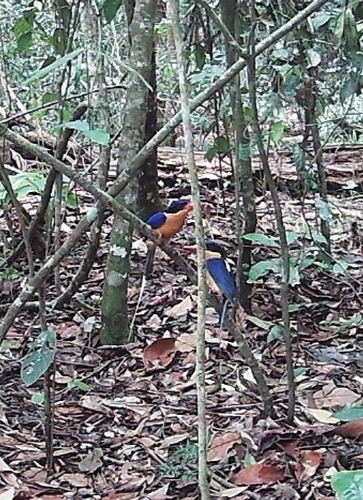
The banded kingfisher is 20 cm (7.9 in) long with a sturdy red bill and a short crest which is slowly raised and lowered. It shows striking sexual dimorphism compared to most of its relatives. The adult male has a chestnut forehead, cheeks and nape, and a bright blue cap. The rest of the upperparts, wings and tail are black with blue bands. The breast, flanks and undertail are rufous, and the central belly is white. The adult female is equally striking, with black-and-rufous-banded upperparts, and white underparts with some black bars on the chest and flanks.
ID text from Wikipedia, CC BY-SA 4.0
Buff-breasted Paradise Kingfisher
Tanysiptera sylvia
Like all paradise kingfishers, the buff-breasted is brightly coloured with a large red bill, rich rufous-buff underparts, blue or purple cap, crown and outer tail feathers, black eye stripes running down to the nape of its neck, red feet, white lower back and rump and long white or blue-and-white tail-feathers which varies geographically. The identifying feature is the white patch on the centre of the upper back. The juvenile has a brown bill, yellowish feet, is duller and lacks long tail feathers. An adult male is 35 cm (14 in) in length including the tail feathers which extend 13 cm (5. Voice: Despite its bright colours, the buff-breasted paradise kingfisher is often difficult to see in the rainforest and is best located by its distinctive calls. It is usually noisier early in the season when the males are establishing territories and courting. Based on studies in New Guinea the bird calls much less frequently during the non-breeding season.
ID text from Wikipedia, CC BY-SA 4.0
Learn this pair in the BeakBrain App
Photo and call practice. Coming soon to iPhone and Android.
Play today's Daily BirdPhotos and recordings are credited to their authors under the licence shown. Full profiles: Banded Kingfisher and Buff-breasted Paradise Kingfisher.