Learn what every symbol on the card means.Full credits and sources at beakbrain.com/symbols
 WoodlandCup nestMedium · 285 g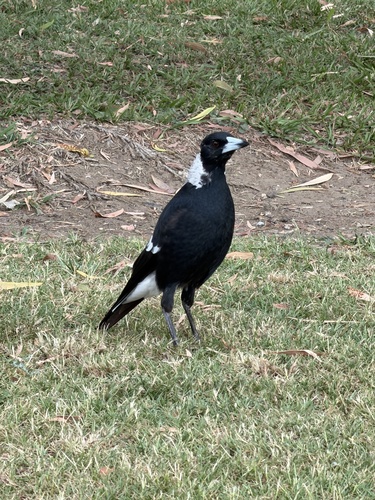
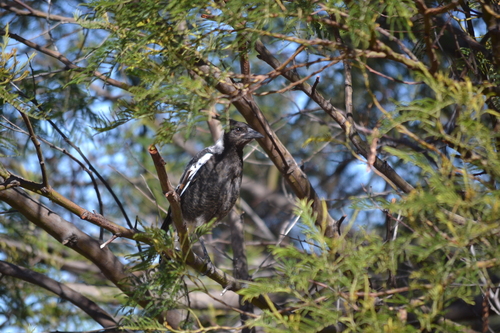


What the Australian Magpie sounds like


ID tip
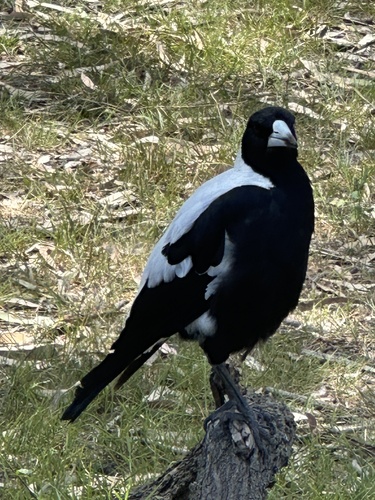
The adult magpie ranges from 37 to 43 cm (14.5 to 17 in) in length with a 65–85 cm (25.5–33.5 in) wingspan, and weighing 220–350 g (7.8–12.3 oz). Its robust wedge-shaped bill is bluish-white bordered with black, with a small hook at the tip. The black legs are long and strong. The plumage is pure glossy black and white; both sexes of all subspecies have black heads, wings and underparts with white shoulders. The tail has a black terminal band. The nape is white in the male and light greyish-white in the female.
Text from Wikipedia, licensed CC BY-SA 4.0.
When to see the Australian Magpie
One bar for each month, and every month is filled: this bird is recorded here in all twelve. The wide bar is October, the month with the most records.
Where to see the Australian Magpie
The map shades 5 countries with regular records, and 1 more in a lighter tone where the bird turns up only as a stray. Everything unshaded has no records. Countries are listed below the map.
Recorded as a rare visitor in Japan.
About the Australian Magpie
The Australian magpie is a black and white passerine bird native to Australia and southern New Guinea, and introduced to New Zealand, and the Fijian island of Taveuni. Although once considered to be three separate species, it is now considered to be one, with nine recognised subspecies. A member of the Artamidae, the Australian magpie is placed in its own genus Gymnorhina and is most closely related to the black butcherbird. It is not closely related to the Eurasian magpie, which is a corvid.
Text adapted from Wikipedia, licensed CC BY-SA 4.0.
Easily confused with
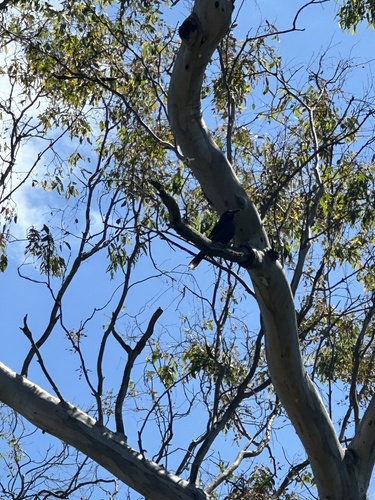 Pied CurrawongStrepera graculinaThe pied currawong is generally a black bird with white in the wing, undertail coverts, the base of the tail and most visibly, the tip of the tail.
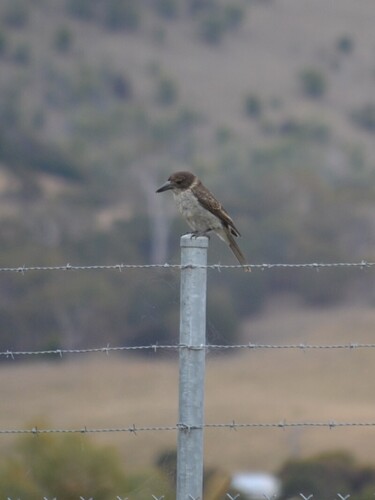 Grey ButcherbirdCracticus torquatusThe grey butcherbird is a small grey, black and white bird with a weight of 90 grams (3.2 ounces), a body length between 27 and 30 cm (11 and 12 in) and a wing span expanding 37–43 cm (15–17 in).
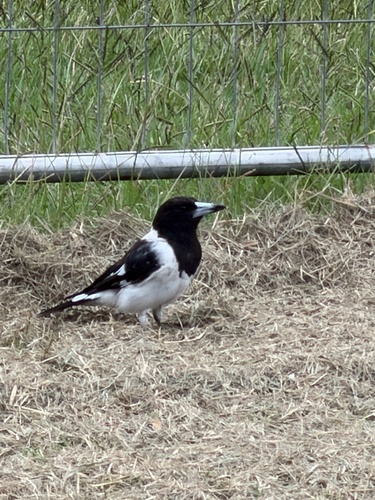 Pied ButcherbirdCracticus nigrogularisLike other butcherbirds, the pied butcherbird is stockily built with short legs and a relatively large head.
Side by side: Australian Magpie vs Pied Currawong · Australian Magpie vs Grey Butcherbird · Australian Magpie vs Pied Butcherbird
Learn the Australian Magpie in the BeakBrain App
Photo and call practice. Coming soon to iPhone and Android.
Play today's Daily BirdEvery photo and recording on this page is credited to its author under the licence shown. Spotted a problem with this page, or have a better photo? Contribute.