Learn what every symbol on the card means.Full credits and sources at beakbrain.com/symbols
 ForestCup nestSmall · 42 g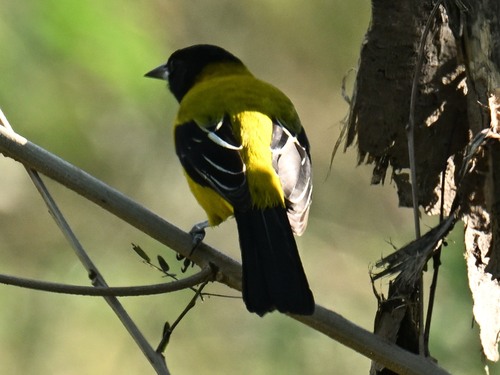


What the Audubon's Oriole sounds like

ID tip
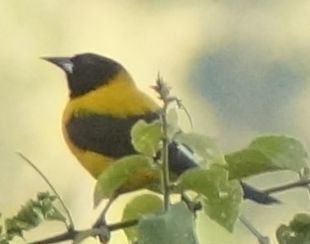
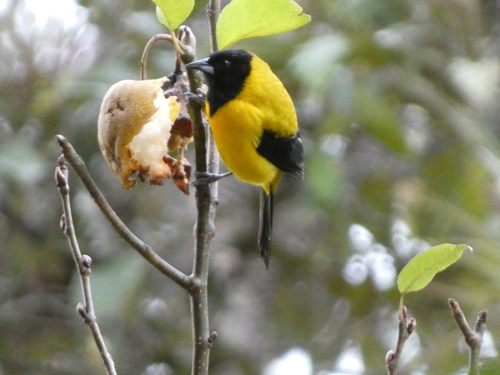
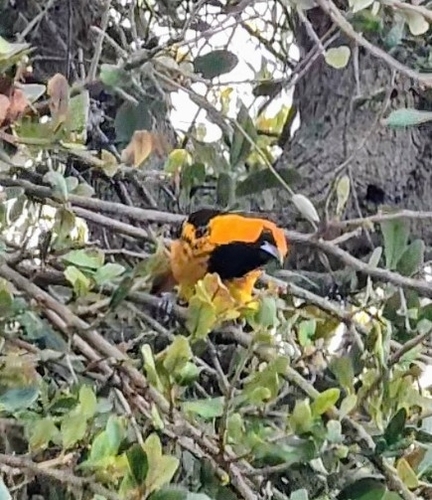
The male of the species has a black hood, mandible, and throat, as well as a black tail. Wings are black, but the remiges and rectrices (flight feathers) are fringed with white. The secondary coverts form yellow epaulets. The back and vent are yellow washed with olive, and the underside is almost uniformly yellow. Females of this species have a slightly more olive nape and back than the males. The adult female's plumage is similar to the juvenile plumage; however, unlike adults, the wings are dull brown instead of black. Voice: The song of the Audubon's oriole is a series of slow, slurry whistles. Its calls include a nasal "ike, ike, ike" and a whistled "peu".
Text from Wikipedia, licensed CC BY-SA 4.0.
When to see the Audubon's Oriole
One bar for each month. Filled bars are the 8 months with records; pale bars are months with none. The wide bar is February, the month with the most records.
Where to see the Audubon's Oriole
The map shades 2 countries with regular records. Everything unshaded has no records. Countries are listed below the map.
About the Audubon's Oriole
Audubon's oriole, formerly known as the black-headed oriole, is a New World passerine inhabiting the forests and thickets of southeastern Texas and the Mexican coast. It is the only species to have a black hood and yellow body. It is divided into four subspecies and two allopatric breeding ranges. The westernmost range extends from Nayarit south to southern Oaxaca, whereas the eastern range stretches from the lower Rio Grande valley to northern Querétaro. The most common in the western range are the subspecies I. g. dickeyae and I. g. nayaritensis; I. g. graduacauda and I. g. audubonii can be found in the eastern range.
Text adapted from Wikipedia, licensed CC BY-SA 4.0.
Easily confused with
 Black-vented OrioleIcterus wagleriThe black-vented oriole is 20.5 to 23 cm (8.1 to 9.1 in) long.
 Yellow-tailed OrioleIcterus mesomelasThe yellow-tailed oriole is a passerine bird in the New World family Icteridae.
 Spot-breasted OrioleIcterus pectoralisThe spot-breasted oriole is about 21 cm (8.3 in) long.
Side by side: Audubon's Oriole vs Spot-breasted Oriole · Audubon's Oriole vs Black-vented Oriole
Learn the Audubon's Oriole in the BeakBrain App
Photo and call practice. Coming soon to iPhone and Android.
Play today's Daily BirdEvery photo and recording on this page is credited to its author under the licence shown. Spotted a problem with this page, or have a better photo? Contribute.