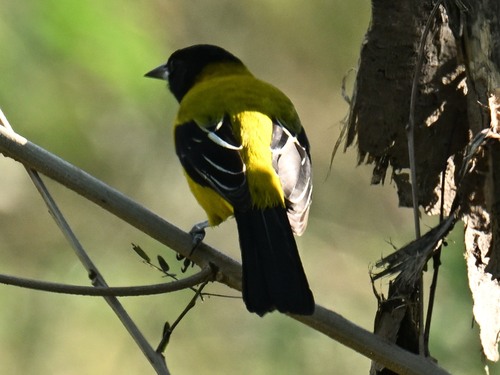
Audubon's Oriole
Icterus graduacauda
The male of the species has a black hood, mandible, and throat, as well as a black tail. Wings are black, but the remiges and rectrices (flight feathers) are fringed with white. The secondary coverts form yellow epaulets. The back and vent are yellow washed with olive, and the underside is almost uniformly yellow. Females of this species have a slightly more olive nape and back than the males. The adult female's plumage is similar to the juvenile plumage; however, unlike adults, the wings are dull brown instead of black. Voice: The song of the Audubon's oriole is a series of slow, slurry whistles. Its calls include a nasal "ike, ike, ike" and a whistled "peu".
ID text from Wikipedia, CC BY-SA 4.0

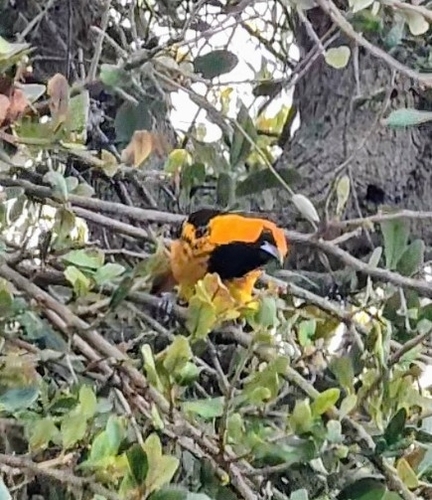
Spot-breasted Oriole
Icterus pectoralis
The spot-breasted oriole is about 21 cm (8.3 in) long. Its wing chord is 8.8 to 11.4 cm (3.5 to 4.5 in), its tail 8.5 to 11.2 cm (3.3 to 4.4 in), its culmen 1.9 to 2.4 cm (0.75 to 0.94 in), and its tarsus 2.6–3 cm (1.0–1.2 in). Males weigh an average of about 53 g (1.9 oz) and females about 45 g (1.6 oz). The sexes have the essentially same plumage though females are duller than males. Adults of the nominate subspecies I. p. pectoralis have a mostly deep orange head and nape. They have a black "mask", throat, "bib" on the upper breast, mantle, and back. Their rump is orange. Voice: The spot-breasted oriole's song is "a sweet, melodic rising and falling series of repeated clear whistles: eeeep!-weu'peeer-eeeep!-weu'peeer-eeeep!-weu'peeer..." and its calls include "a harsh, scratchy, nasal raannk...and a hoarse chatter".
ID text from Wikipedia, CC BY-SA 4.0
Where you might meet both
Learn this pair in the BeakBrain App
Photo and call practice. Coming soon to iPhone and Android.
Play today's Daily BirdPhotos and recordings are credited to their authors under the licence shown. Full profiles: Audubon's Oriole and Spot-breasted Oriole.