Learn what every symbol on the card means.Full credits and sources at beakbrain.com/symbols
 ForestCup nestSmall · 42 g


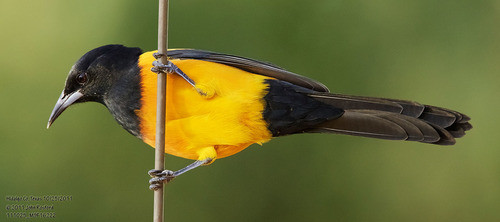
ID tip
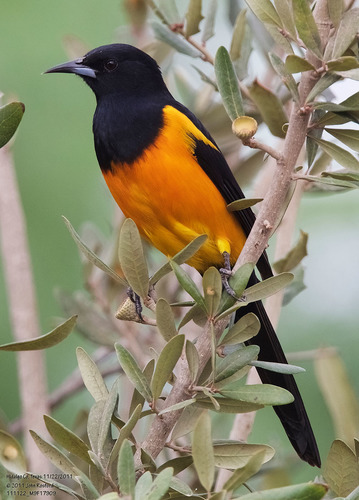
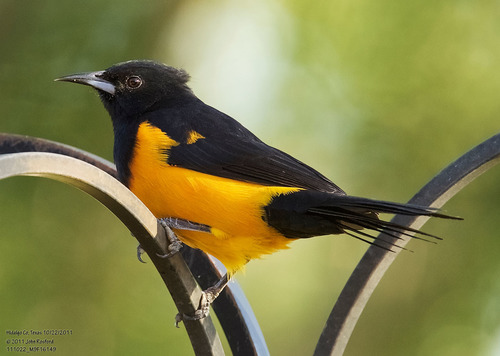
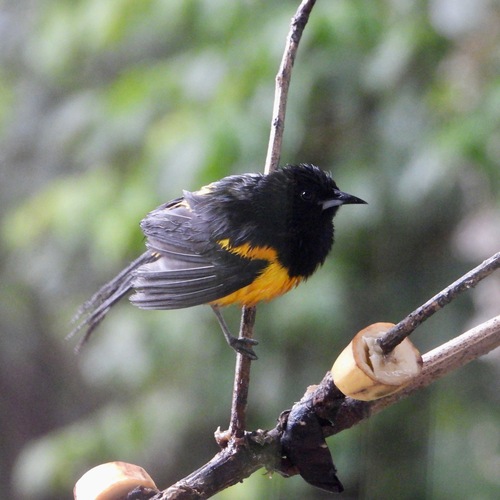
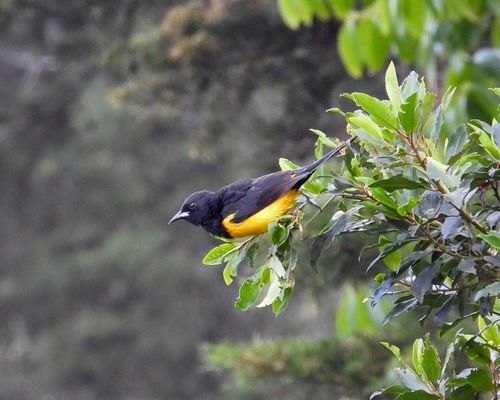
The black-vented oriole is 20.5 to 23 cm (8.1 to 9.1 in) long. Males weigh an average of about 41 g (1.4 oz) and females an average of 39 g (1.4 oz). Adult males of the nominate subspecies have a black head, throat, upper breast, mantle, back, rump, uppertail coverts, and tail. Their lowermost belly and undertail coverts are also black. Their wing is mostly black with orange-yellow lesser and median coverts that show as an epaulet on the closed wing. Their underparts have a tinge of chestnut just below the black breast and are otherwise orange-yellow. Voice: The black-vented oriole has a rather unmusical song that is "a mix of fast warbles with twittering and nasal or rasping notes". Its call is "a distinctive nasal eeeaahnk!".
Text from Wikipedia, licensed CC BY-SA 4.0.
When to see the Black-vented Oriole
One bar for each month, and every month is filled: this bird is recorded here in all twelve. The wide bar is March, the month with the most records.
Where to see the Black-vented Oriole
The map shades 5 countries with regular records, and 1 more in a lighter tone where the bird turns up only as a stray. Everything unshaded has no records. Countries are listed below the map.
Recorded as a rare visitor in United States.
About the Black-vented Oriole
The black-vented oriole is a species of bird in the family Icteridae, the oropendolas, New World orioles, and New World blackbirds.. It is found in El Salvador, Guatemala, Honduras, Mexico, and Nicaragua and has reached the United States as a vagrant.
Text adapted from Wikipedia, licensed CC BY-SA 4.0.
Easily confused with
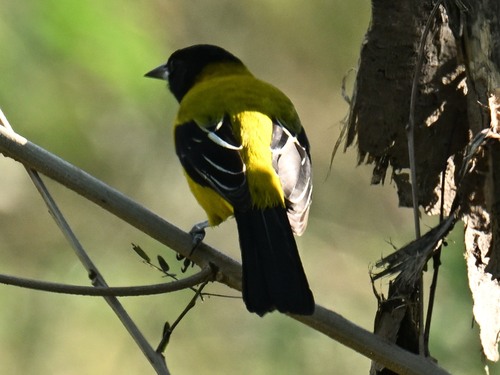 Audubon's OrioleIcterus graduacaudaThe male of the species has a black hood, mandible, and throat, as well as a black tail.
 Yellow-tailed OrioleIcterus mesomelasThe yellow-tailed oriole is a passerine bird in the New World family Icteridae.
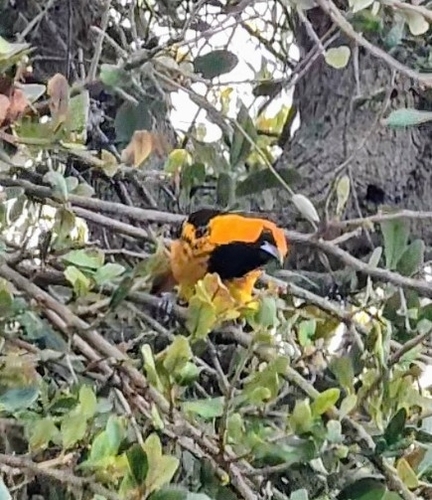 Spot-breasted OrioleIcterus pectoralisThe spot-breasted oriole is about 21 cm (8.3 in) long.
Side by side: Black-vented Oriole vs Spot-breasted Oriole · Audubon's Oriole vs Black-vented Oriole
Learn the Black-vented Oriole in the BeakBrain App
Photo and call practice. Coming soon to iPhone and Android.
Play today's Daily BirdEvery photo and recording on this page is credited to its author under the licence shown. Spotted a problem with this page, or have a better photo? Contribute.