Learn what every symbol on the card means.Full credits and sources at beakbrain.com/symbols
 WoodlandPlatform nestSmall · 57 g


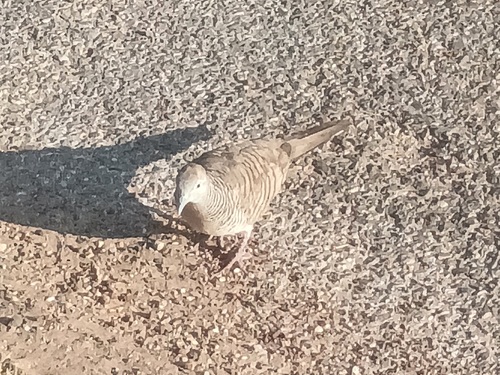
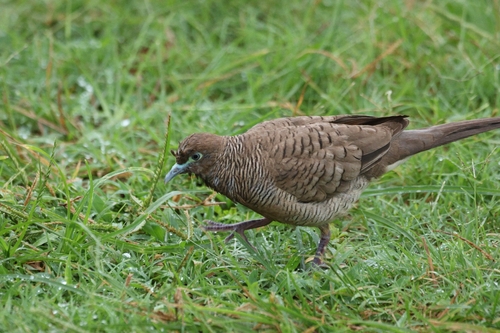
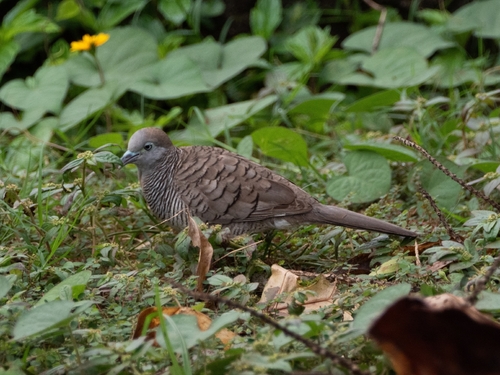
What the Zebra Dove sounds like


ID tip
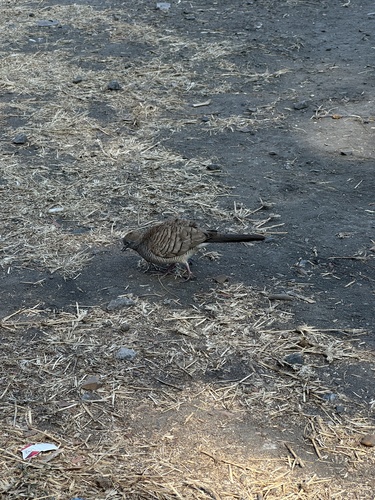
The birds are small and slender with a long, narrow tail. The upperparts are brownish-grey with black-and-white barring. The underparts are pinkish with black bars on the sides of the neck, breast and belly. The face is blue-grey with bare blue skin around the eyes. There are white tips to the tail feathers. Juveniles are duller and paler than the adults. They can also have brown feathers. Zebra doves are 20–23 centimetres in length with a wingspan of 24–26 cm. Their call is a series of soft, staccato cooing notes.
Text from Wikipedia, licensed CC BY-SA 4.0.
When to see the Zebra Dove
One bar for each month, and every month is filled: this bird is recorded here in all twelve. The wide bar is January, the month with the most records.
Where to see the Zebra Dove
The map shades 20 countries with regular records, and 6 more in a lighter tone where the bird turns up only as a stray. Everything unshaded has no records. Countries are listed below the map.
Recorded as a rare visitor in Portugal, Australia, South Africa, Bahrain, United Arab Emirates, Maldives.
About the Zebra Dove
The zebra dove, also known as the barred ground dove, or barred dove, is a species of bird of the dove family, Columbidae, native to Southeast Asia. They are small birds with a long tail, predominantly brownish-grey in colour with black-and-white barring. The species is known for its pleasant, soft, staccato cooing calls.
Text adapted from Wikipedia, licensed CC BY-SA 4.0.
Easily confused with
 Peaceful DoveGeopelia placidaThe bird is a relatively small pigeon and varies in length from 19 to 21 centimetres (7.6 to 8.4 inches).
 Bar-shouldered DoveGeopelia humeralisThe dove has a blue-grey breast with chequered brown-bronze wings.
 Diamond DoveGeopelia cuneataThey are small pigeons with a length of 19 to 21 centimeters or 9 to 11 inches.
Side by side: Peaceful Dove vs Zebra Dove · Bar-shouldered Dove vs Zebra Dove · Diamond Dove vs Zebra Dove
Learn the Zebra Dove in the BeakBrain App
Photo and call practice. Coming soon to iPhone and Android.
Play today's Daily BirdEvery photo and recording on this page is credited to its author under the licence shown. Spotted a problem with this page, or have a better photo? Contribute.