Learn what every symbol on the card means.Full credits and sources at beakbrain.com/symbols
 ForestPlatform nestMedium · 64 g


What the Yellow-billed Cuckoo sounds like


ID tip
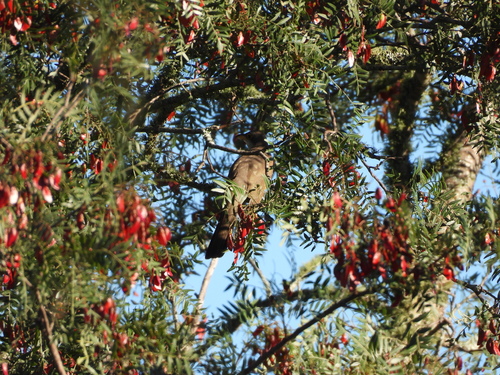
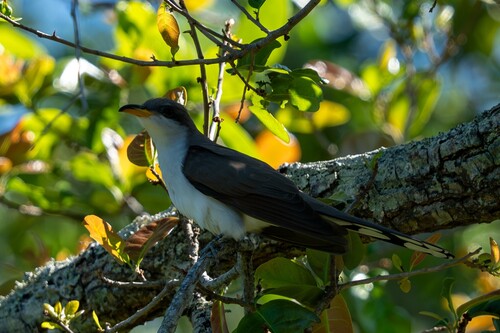
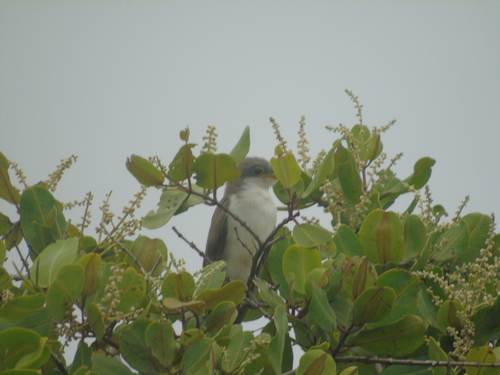
Adults have a long tail, brown above and black-and-white below, and a black curved bill with yellow especially on the lower mandible. The head and upper parts are brown and the underparts are white. There is a yellow ring around the eye. It shows cinnamon on the wings in flight. Juveniles are similar, but the black on the undertail is replaced by gray. The adults show no sexual dimorphism, and thus the males and females can't be told apart by plumage. Measurements: Length: 10.2-11.8 in (26–30 cm) Weight: 1.9-2.3 oz (55–65 g) Wingspan: 15.0-16.9 in (38–43 cm)
Text from Wikipedia, licensed CC BY-SA 4.0.
When to see the Yellow-billed Cuckoo
One bar for each month. Filled bars are the 7 months with records; pale bars are months with none. The wide bar is May, the month with the most records.
Where to see the Yellow-billed Cuckoo
The map shades 51 countries with regular records, and 4 more in a lighter tone where the bird turns up only as a stray. Everything unshaded has no records. Countries are listed below the map.
Recorded as a rare visitor in United Kingdom, France, Chile, Belgium.
About the Yellow-billed Cuckoo
The yellow-billed cuckoo is a member of the cuckoo family. Common folk names for this bird in the southern United States are rain crow and storm crow. These likely refer to the bird's habit of calling on hot days, often presaging rain showers or thunderstorms. The genus name is from the Ancient Greek kokkuzo, which means to call like a common cuckoo, and americanus means "of America".
Text adapted from Wikipedia, licensed CC BY-SA 4.0.
Easily confused with
 Black-billed CuckooCoccyzus erythropthalmusAdults have a long, graduated brown tail and a black, slightly downcurved bill.
 Mangrove CuckooCoccyzus minorAdults have a long tail, brown above and black-and-white below, and a black curved bill with yellow on the lower mandible.
 Dark-billed CuckooCoccyzus melacoryphusThe dark-billed cuckoo is 25 to 28 cm (9.8 to 11.0 in) long, about half of which is the tail.
Side by side: Black-billed Cuckoo vs Yellow-billed Cuckoo · Mangrove Cuckoo vs Yellow-billed Cuckoo · Dark-billed Cuckoo vs Yellow-billed Cuckoo
Learn the Yellow-billed Cuckoo in the BeakBrain App
Photo and call practice. Coming soon to iPhone and Android.
Play today's Daily BirdEvery photo and recording on this page is credited to its author under the licence shown. Spotted a problem with this page, or have a better photo? Contribute.