Learn what every symbol on the card means.Full credits and sources at beakbrain.com/symbols
 WoodlandPlatform nestMedium · 64 g


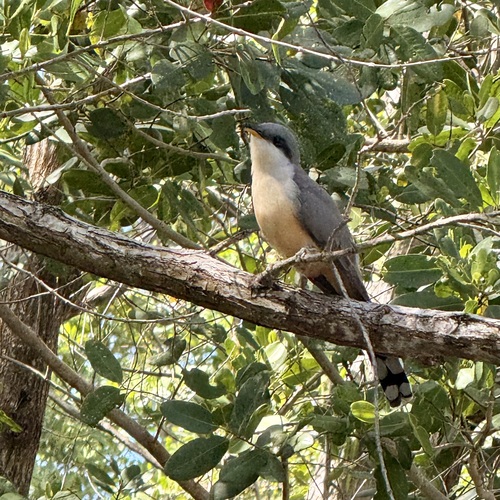
ID tip
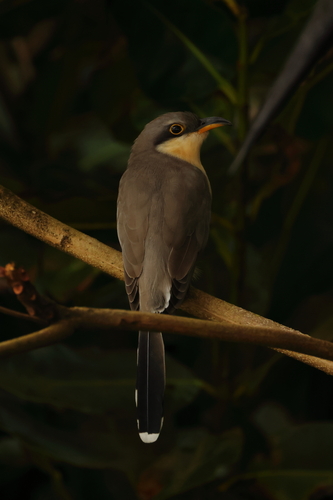
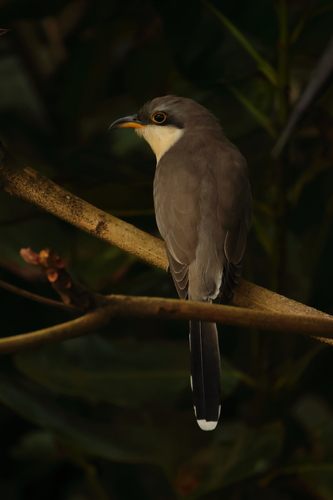
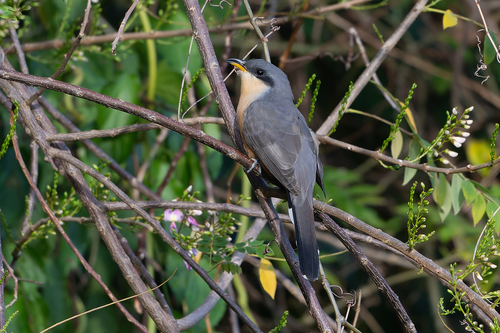
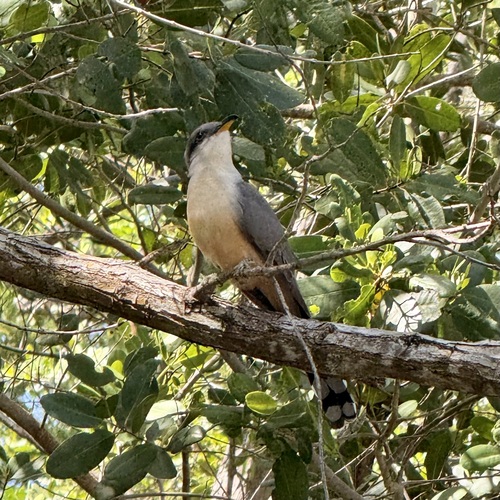
Adults have a long tail, brown above and black-and-white below, and a black curved bill with yellow on the lower mandible. The head and upper parts are brown. There is a yellow ring around the eye. This bird is best distinguished by its black facial mask and buffy underparts. Although the scientific name is minor (meaning "small"), this species is on average the largest of North America's three Coccyzus cuckoos. Adults measure 28–34 cm (11–13 in) in length, weigh 64–102 g (2.3–3.6 oz) and span 38–43 cm (15–17 in) across the wings.
Text from Wikipedia, licensed CC BY-SA 4.0.
When to see the Mangrove Cuckoo
One bar for each month. Filled bars are the 10 months with records; pale bars are months with none. The wide bar is March, the month with the most records.
Where to see the Mangrove Cuckoo
The map shades 41 countries with regular records. Everything unshaded has no records. Countries are listed below the map.
About the Mangrove Cuckoo
The mangrove cuckoo is a species of cuckoo that is native to the Neotropics.
Text adapted from Wikipedia, licensed CC BY-SA 4.0.
Easily confused with
 Dark-billed CuckooCoccyzus melacoryphusThe dark-billed cuckoo is 25 to 28 cm (9.8 to 11.0 in) long, about half of which is the tail.
 Great Lizard CuckooCoccyzus merliniThe great lizard cuckoo is the largest species in genus Coccyzus.
 Puerto Rican Lizard CuckooCoccyzus vieillotiThe Puerto Rican lizard cuckoo is 40 to 48 cm (16 to 19 in) long, about half of which is the tail.
Side by side: Mangrove Cuckoo vs Yellow-billed Cuckoo · Black-billed Cuckoo vs Mangrove Cuckoo · Dark-billed Cuckoo vs Mangrove Cuckoo · Great Lizard Cuckoo vs Mangrove Cuckoo · Mangrove Cuckoo vs Puerto Rican Lizard Cuckoo
Learn the Mangrove Cuckoo in the BeakBrain App
Photo and call practice. Coming soon to iPhone and Android.
Play today's Daily BirdEvery photo and recording on this page is credited to its author under the licence shown. Spotted a problem with this page, or have a better photo? Contribute.