Learn what every symbol on the card means.Full credits and sources at beakbrain.com/symbols
 ForestPlatform nestMedium · 170 g


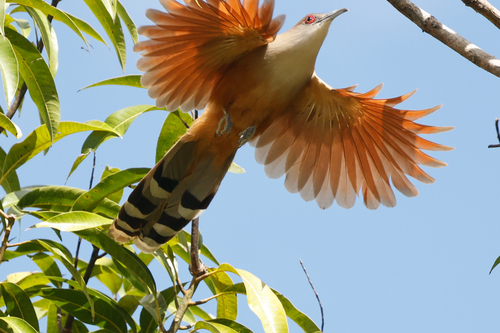
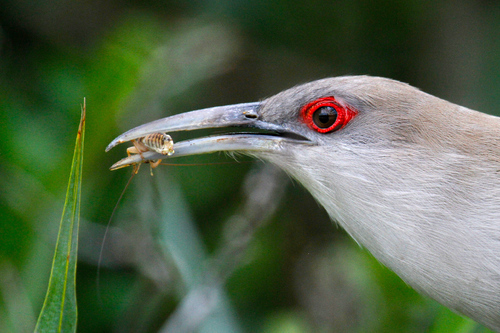
ID tip
The great lizard cuckoo is the largest species in genus Coccyzus. It is 42 to 54 cm (17 to 21 in) long, about half of which is the tail, and weighs about 100 to 155 g (3.5 to 5.5 oz). Both sexes within each subspecies have the same plumage, but males are larger than females. The species' bill is long and almost straight, with a black or dusky maxilla and a paler mandible. Adults of the nominate subspecies C. m. merlini have an olive-brown crown, nape, and upperparts. Their primaries are rufous, but that color often only shows in flight. Voice: The great lizard cuckoo's principal vocalization is the "Long Call", described as "a throaty ka-ka-ka-ka-ka-ka-kau-kau-ko-ko...with the second part gradually increasing in volume and increasing slightly in the speed of delivery before finally slowing again". It calls at any time of day, but sporadically.
Text from Wikipedia, licensed CC BY-SA 4.0.
When to see the Great Lizard Cuckoo
One bar for each month. Filled bars are the 8 months with records; pale bars are months with none. The wide bar is March, the month with the most records.
Where to see the Great Lizard Cuckoo
The map shades 2 countries with regular records. Everything unshaded has no records. Countries are listed below the map.
About the Great Lizard Cuckoo
The great lizard cuckoo is a species of bird in the tribe Phaenicophaeini, subfamily Cuculinae of the cuckoo family Cuculidae. It is found in the Bahamas and Cuba.
Text adapted from Wikipedia, licensed CC BY-SA 4.0.
Easily confused with
 Puerto Rican Lizard CuckooCoccyzus vieillotiThe Puerto Rican lizard cuckoo is 40 to 48 cm (16 to 19 in) long, about half of which is the tail.
 Hispaniolan Lizard CuckooCoccyzus longirostrisThe Hispaniolan lizard cuckoo is 41 to 46 cm (16 to 18 in) long, about half of which is the tail.
 Dark-billed CuckooCoccyzus melacoryphusThe dark-billed cuckoo is 25 to 28 cm (9.8 to 11.0 in) long, about half of which is the tail.
Side by side: Black-billed Cuckoo vs Great Lizard Cuckoo · Great Lizard Cuckoo vs Mangrove Cuckoo · Dark-billed Cuckoo vs Great Lizard Cuckoo · Great Lizard Cuckoo vs Puerto Rican Lizard Cuckoo · Great Lizard Cuckoo vs Hispaniolan Lizard Cuckoo
Learn the Great Lizard Cuckoo in the BeakBrain App
Photo and call practice. Coming soon to iPhone and Android.
Play today's Daily BirdEvery photo and recording on this page is credited to its author under the licence shown. Spotted a problem with this page, or have a better photo? Contribute.