Learn what every symbol on the card means.Full credits and sources at beakbrain.com/symbols
 ForestCup nestTiny · 7 g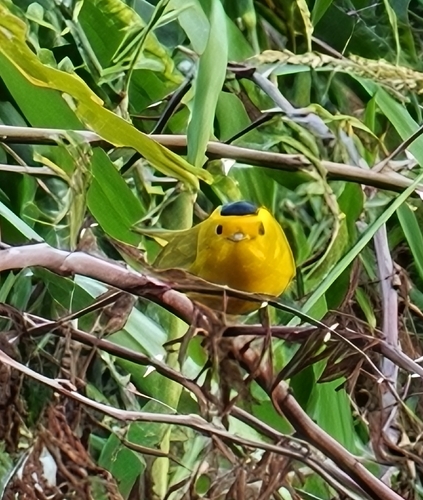


What the Wilson's Warbler sounds like


ID tip
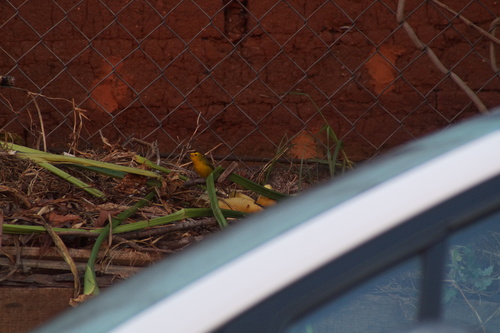
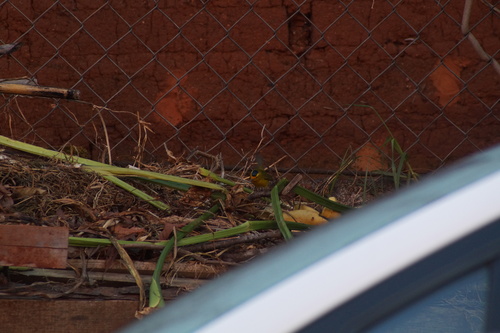
Wilson's warbler is a small passerine, ranging from 10 to 12 cm (3.9 to 4.7 in) in length, with a wingspan of 14–17 cm (5.5–6.7 in) and a mass of 5–10 g (0.18–0.35 oz). It has a plain green-brown back and yellow underparts. The male has a small black cap. Males of the western race C. p. chryseola are greener above and brighter than males of the eastern, nominate race. Individuals from Alaska and the west-central portion of the species' range average slightly larger than those found in eastern and Pacific coastal populations. Its song is a chattering series of loud descending notes.
Text from Wikipedia, licensed CC BY-SA 4.0.
When to see the Wilson's Warbler
One bar for each month. Filled bars are the 6 months with records; pale bars are months with none. The wide bar is May, the month with the most records.
Where to see the Wilson's Warbler
The map shades 19 countries with regular records, and 3 more in a lighter tone where the bird turns up only as a stray. Everything unshaded has no records. Countries are listed below the map.
Recorded as a rare visitor in Portugal, United Kingdom, Ireland.
About the Wilson's Warbler
Wilson's warbler is a small New World warbler. It is greenish above and yellow below, with rounded wings and a long, slim tail. The male has a black crown patch; depending on the subspecies, that mark is reduced or absent in the female. It breeds across Canada and south through the western United States, and winters from Mexico south through much of Central America. It is a very rare vagrant to western Europe.
Text adapted from Wikipedia, licensed CC BY-SA 4.0.
Easily confused with
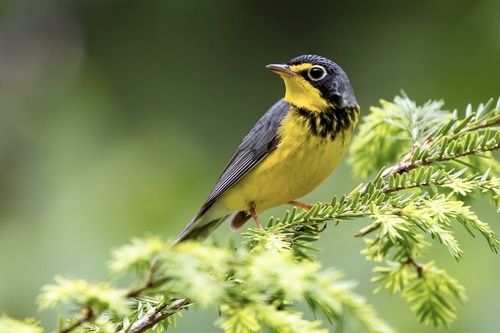 Canada WarblerCardellina canadensisThe Canada warbler is sometimes called the "necklaced warbler", because of the band of dark streaks across its chest.
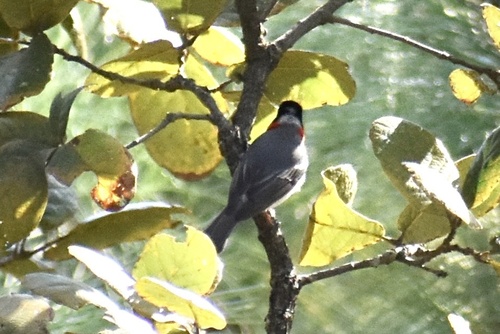 Red-faced WarblerCardellina rubrifronsThe red-faced warbler is a species of New World warbler.
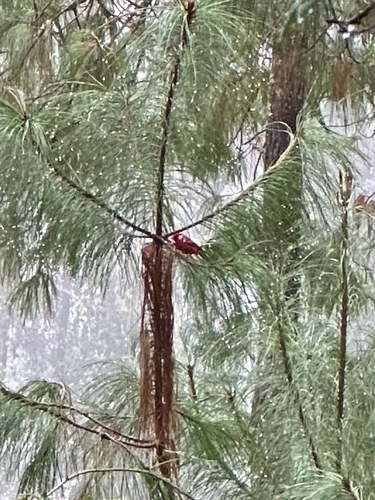 Red WarblerCardellina rubraThe red warbler is a small passerine, measuring 12.5–13.5 cm (4.9–5.3 in) in length, and weighing from 7.6 to 8.7 g (0.27 to 0.31 oz).
Side by side: Canada Warbler vs Wilson's Warbler · Red Warbler vs Wilson's Warbler
Learn the Wilson's Warbler in the BeakBrain App
Photo and call practice. Coming soon to iPhone and Android.
Play today's Daily BirdEvery photo and recording on this page is credited to its author under the licence shown. Spotted a problem with this page, or have a better photo? Contribute.