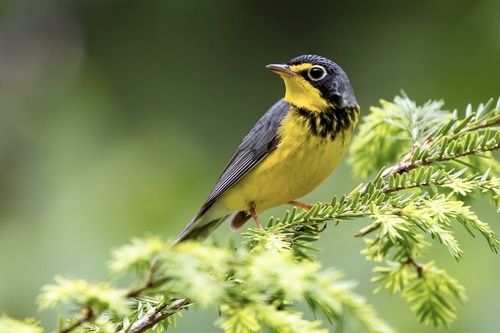
Canada Warbler
Cardellina canadensis
The Canada warbler is sometimes called the "necklaced warbler", because of the band of dark streaks across its chest. The adults have minimal sexual dimorphism, although the male's "necklace" is darker and more conspicuous and also has a longer tail. Adults are 12–15 cm (4.7–5.9 in) long, have a wingspan of 17–22 cm (6.7–8.7 in), and weigh 9–13 g (0.32–0.46 oz). The chest, throat, and belly of the bird are yellow, and its back is dark grey. It has no wingbars or tail spots, but the underside of the tail is white. Voice: The of this bird is loud and highly variable, resembling chip chewy sweet dichetty. Their calls are low chup's. A 2013 study showed that male Canada warblers have two performance-encoded song types. Mode I, used mostly during the day, when unpaired either alone or near a female during early nesting, involves stereotyped songs sung slowly and regularly.
ID text from Wikipedia, CC BY-SA 4.0

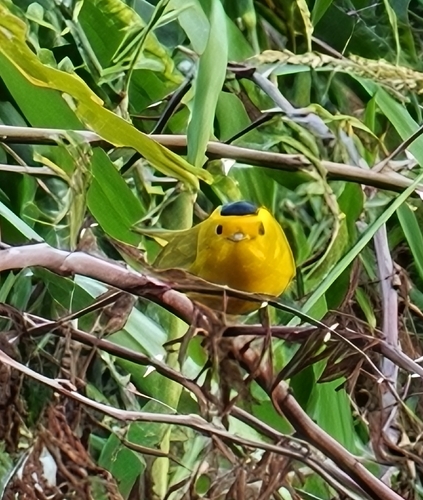
Wilson's Warbler
Cardellina pusilla
Wilson's warbler is a small passerine, ranging from 10 to 12 cm (3.9 to 4.7 in) in length, with a wingspan of 14–17 cm (5.5–6.7 in) and a mass of 5–10 g (0.18–0.35 oz). It has a plain green-brown back and yellow underparts. The male has a small black cap. Males of the western race C. p. chryseola are greener above and brighter than males of the eastern, nominate race. Individuals from Alaska and the west-central portion of the species' range average slightly larger than those found in eastern and Pacific coastal populations. Its song is a chattering series of loud descending notes.
ID text from Wikipedia, CC BY-SA 4.0

Where you might meet both
Learn this pair in the BeakBrain App
Photo and call practice. Coming soon to iPhone and Android.
Play today's Daily BirdPhotos and recordings are credited to their authors under the licence shown. Full profiles: Canada Warbler and Wilson's Warbler.