Learn what every symbol on the card means.Full credits and sources at beakbrain.com/symbols
 MarineCavity nestSmall · 30 g


What the Wilson's Storm Petrel sounds like


ID tip
Wilson's storm petrel is a small bird, 16–18.5 cm (6.3–7.3 in) in length with a 38–42 cm (15–16.5 in) wingspan. It is slightly larger than the European storm petrel and is essentially dark brown in all plumages, except for the white rump and flanks. The feet extend just beyond the square ended tail in flight. The European storm petrel has a very distinct whitish lining to the underwing and a nearly all dark upperwing. Wilson's storm petrel has a diffuse pale band along the upper wing coverts and lacks the distinctive white underwing lining.
Text from Wikipedia, licensed CC BY-SA 4.0.
When to see the Wilson's Storm Petrel
One bar for each month. Filled bars are the 9 months with records; pale bars are months with none. The wide bar is August, the month with the most records.
Where to see the Wilson's Storm Petrel
The map shades 47 countries with regular records, and 19 more in a lighter tone where the bird turns up only as a stray. Everything unshaded has no records. Countries are listed below the map.
Recorded as a rare visitor in Taiwan, Mexico, Colombia, Morocco, Costa Rica, Mauritania, Gabon, China, Iceland, French Polynesia, Mauritius, Mayotte, Anguilla, Greenland, Grenada, Martinique, Panama, St. Barthélemy, Singapore.
About the Wilson's Storm Petrel
Wilson's storm petrel, also known as Wilson's petrel, is a small seabird of the austral storm petrel family Oceanitidae. It is one of the most abundant bird species in the world and has a circumpolar distribution mainly in the seas of the southern hemisphere but extending northwards during the summer of the northern hemisphere. The world population was estimated in 2022 as stable at 8–20 million birds. In 2010 it had been estimated at 12–30 million. A 1998 book had estimated more than 50 million pairs. The name commemorates the Scottish-American ornithologist Alexander Wilson. The genus name Oceanites refers to the mythical Oceanids, the three thousand daughters of Tethys.
Text adapted from Wikipedia, licensed CC BY-SA 4.0.
Easily confused with
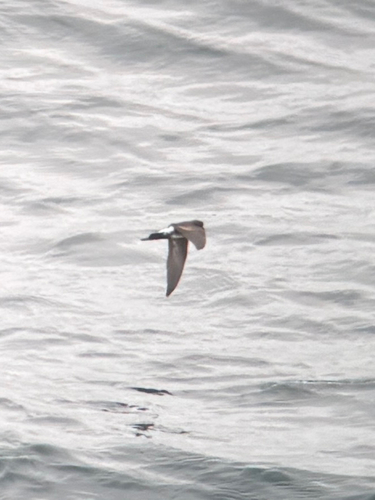 Elliot's Storm PetrelOceanites gracilisElliot's storm petrel is a species of seabird in the storm petrel family Oceanitidae.
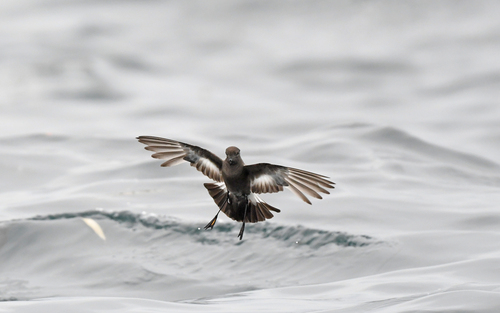 Pincoya Storm PetrelOceanites pincoyaeThe holotype, a female, which was captured, examined, and released afterwards on 19 February 2011 has the following measurements: head and bill length 32.9 mm, exposed culmen length 11.5 mm, bill length from gape 12 mm, flattened wing length from chord 134 mm, tarsus length 31 mm, mid-toe length (with claws) 26.5 mm, tail length 57 mm, wing span 330 mm and a mass of 24 g.
Learn the Wilson's Storm Petrel in the BeakBrain App
Photo and call practice. Coming soon to iPhone and Android.
Play today's Daily BirdEvery photo and recording on this page is credited to its author under the licence shown. Spotted a problem with this page, or have a better photo? Contribute.