Learn what every symbol on the card means.Full credits and sources at beakbrain.com/symbols
 GrasslandGround nest59 g





ID tip
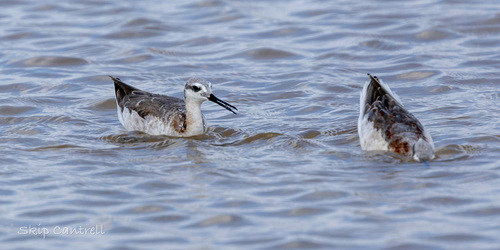
Wilson's phalarope is slightly larger than the red phalarope at about 23 cm (9.1 in) in length. It is a dainty shorebird with lobed toes and a straight fine black bill. The breeding female is predominantly grey and brown above, with white underparts, a reddish neck and reddish flank patches. The breeding male is a duller version of the female, with a brown back, and the reddish patches reduced or absent. Measurements: Length: 22–24 cm (8.7–9.4 in) Weight: male 30–110 g (1.1–3.9 oz), female 52–128 g (1.8–4.
Text from Wikipedia, licensed CC BY-SA 4.0.
When to see the Wilson's Phalarope
One bar for each month. Filled bars are the 6 months with records; pale bars are months with none. The wide bar is May, the month with the most records.
Where to see the Wilson's Phalarope
The map shades 48 countries with regular records, and 16 more in a lighter tone where the bird turns up only as a stray. Everything unshaded has no records. Countries are listed below the map.
Recorded as a rare visitor in Belgium, Spain, Norway, Netherlands, Germany, New Zealand, Australia, Denmark, Greece, Morocco, Curaçao, Grenada, Turks & Caicos Islands, Finland, St. Barthélemy, St. Kitts & Nevis.
About the Wilson's Phalarope
Wilson's phalarope is a small wader. This bird, the largest of the phalaropes, breeds in the prairies of North America in western Canada and the western United States. It is migratory, wintering in inland salt lakes near the Andes in Argentina. They are passage migrants through Central America around March/April and again during September/October. The species is a rare vagrant to western Europe.
Text adapted from Wikipedia, licensed CC BY-SA 4.0.
Easily confused with
 Red-necked PhalaropePhalaropus lobatusThe red-necked phalarope is about 18 cm (7.1 in) in length, with lobed toes and a straight, fine bill.
 Red PhalaropePhalaropus fulicariusThe red phalarope is about 21 cm (8.3 in) in length, with lobed toes and a straight bill, somewhat thicker than that of red-necked phalarope.
Side by side: Red-necked Phalarope vs Wilson's Phalarope · Red Phalarope vs Wilson's Phalarope
Learn the Wilson's Phalarope in the BeakBrain App
Photo and call practice. Coming soon to iPhone and Android.
Play today's Daily BirdEvery photo and recording on this page is credited to its author under the licence shown. Spotted a problem with this page, or have a better photo? Contribute.