Learn what every symbol on the card means.Full credits and sources at beakbrain.com/symbols
 ShrublandCup nestTiny · 7 g
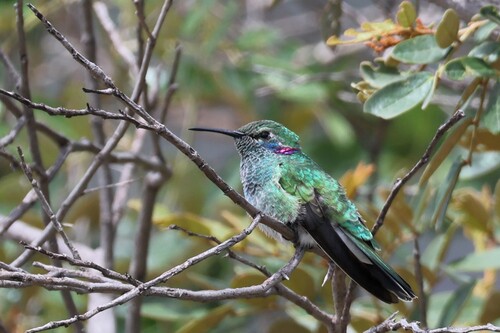
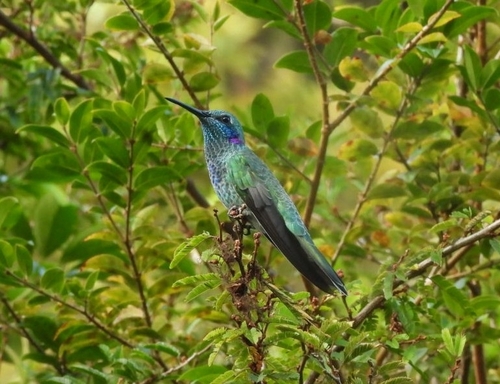
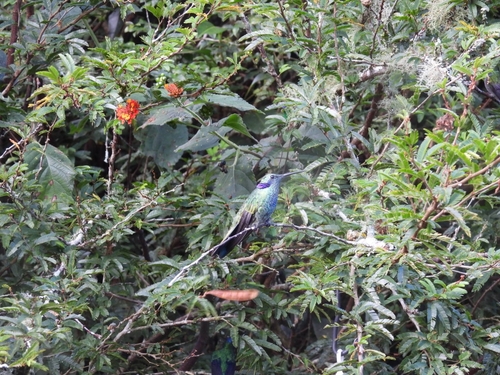
ID tip
The white-vented violetear is 12 to 13 cm (4.7 to 5.1 in) long and weighs 5.6 to 6.8 g (0.20 to 0.24 oz). The male is mostly shiny green, of a shade lighter than that of other violetears. Towards the rump it is yellow-green with a blue shimmer. The tail is glittering green with a wide steel-blue band near the end. The undertail coverts are pure white. The area behind the eye and covering the ears is violet blue. The female is similar to the male but paler and more grayish. The maxilla of both sexes is sometimes serrated, which provides its specific epithet. Voice: The white-vented violetear's song is "a constantly repeated 'tsilp, tsilp, zip, tsalp, tsalp'" that may continue for 25 minutes. Its principal call is "a hard 'drüg, drüg, drüg, drüg, drüg'".
Text from Wikipedia, licensed CC BY-SA 4.0.
When to see the White-vented Violetear
One bar for each month, and every month is filled: this bird is recorded here in all twelve. The wide bar is October, the month with the most records.
Where to see the White-vented Violetear
The map shades 3 countries with regular records. Everything unshaded has no records. Countries are listed below the map.
About the White-vented Violetear
The white-vented violetear is a species of hummingbird in the subfamily Polytminae, the mangoes. It is found in Argentina, Bolivia, Brazil, and Paraguay. In April, 2024, one was also photographed at Batsu Gardens in Costa Rica.
Text adapted from Wikipedia, licensed CC BY-SA 4.0.
Easily confused with
 Mexican VioletearColibri thalassinusThe Mexican violetear is roughly medium-sized by hummingbird standards.
 Brown VioletearColibri delphinaeThe brown violetear is a large hummingbird that breeds at middle elevations in the mountains in Central America, and western and northern South America with isolated populations on Trinidad and in the Brazilian state Bahia.
 Lesser VioletearColibri cyanotusThe lesser violetear is roughly medium-sized by hummingbird standards.
Side by side: Mexican Violetear vs White-vented Violetear · Lesser Violetear vs White-vented Violetear
Learn the White-vented Violetear in the BeakBrain App
Photo and call practice. Coming soon to iPhone and Android.
Play today's Daily BirdEvery photo and recording on this page is credited to its author under the licence shown. Spotted a problem with this page, or have a better photo? Contribute.