Learn what every symbol on the card means.Full credits and sources at beakbrain.com/symbols
 Forest6 g


What the Lesser Violetear sounds like


ID tip
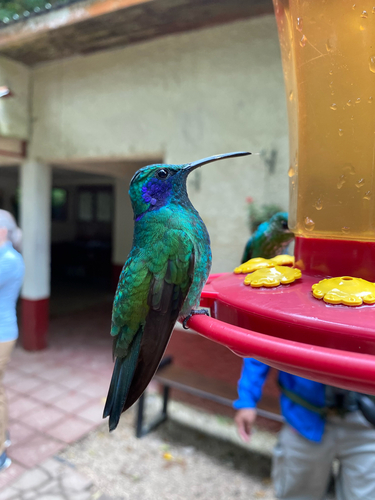
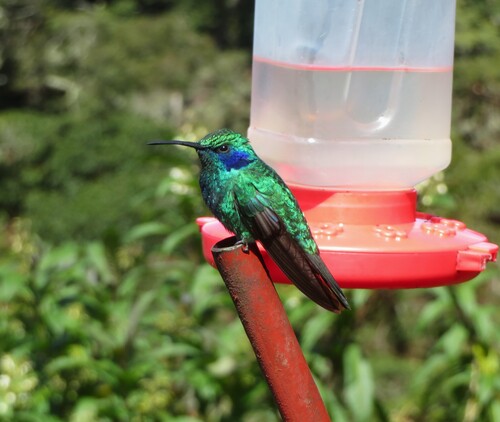
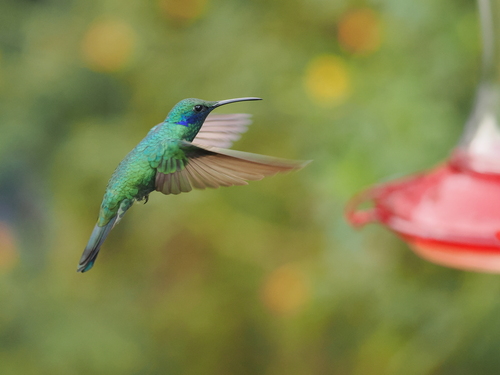
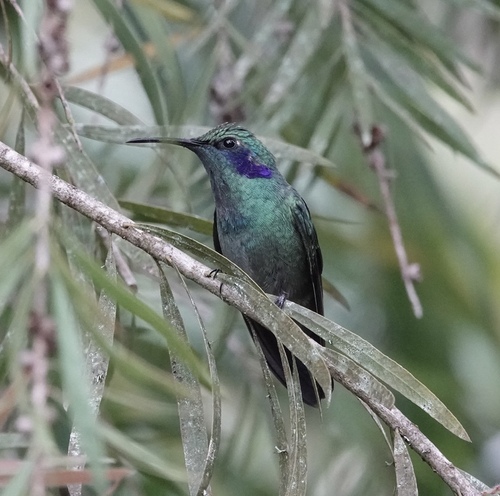
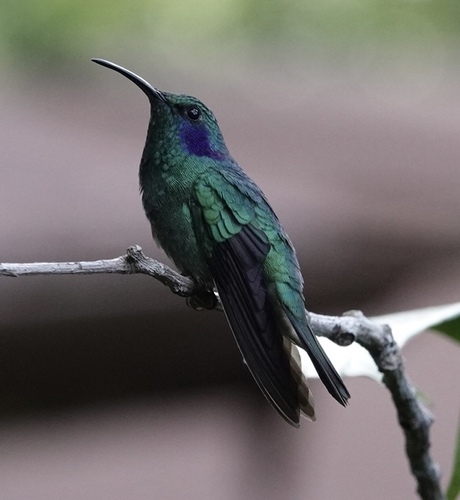
The lesser violetear is roughly medium-sized by hummingbird standards. It averages around 9.7 to 12 cm (3.8 to 4.7 in) in total length. Its bill is black and mostly straight with only a slight downward curve and measures from 1.8 to 2.5 cm (0.71 to 0.98 in). The body mass can vary from 4.8 to 5.6 g (0.17 to 0.20 oz). Among standard measurements, the wing chord is 5.8 to 6.8 cm (2.3 to 2.7 in) and the tail is 3.5 to 4.3 cm (1.4 to 1.7 in). It is shining green above with a glittering violet ear-patch on the sides of its neck. Voice: Solitary males sing from high, exposed twigs in their territory every day. Their song is a monotonously repeated sharp and dry "tsu-tzeek" at a rate of about one call per second.
Text from Wikipedia, licensed CC BY-SA 4.0.
When to see the Lesser Violetear
One bar for each month, and every month is filled: this bird is recorded here in all twelve. The wide bar is February, the month with the most records.
Where to see the Lesser Violetear
The map shades 7 countries with regular records. Everything unshaded has no records. Countries are listed below the map.
About the Lesser Violetear
The lesser violetear, also known as the mountain violet-ear, is a medium-sized, metallic green hummingbird species commonly found in forested areas from Costa Rica south to the Andes and Argentina and east to Venezuela. This species and the Mexican violetear were formerly considered as conspecific and named the 'green violetear'.
Text adapted from Wikipedia, licensed CC BY-SA 4.0.
Easily confused with
 Sparkling VioletearColibri coruscansThe sparkling violetear is the largest violetear at 13 to 14 cm (5 to 5.5 in) long.
 Brown VioletearColibri delphinaeThe brown violetear is a large hummingbird that breeds at middle elevations in the mountains in Central America, and western and northern South America with isolated populations on Trinidad and in the Brazilian state Bahia.
 Mexican VioletearColibri thalassinusThe Mexican violetear is roughly medium-sized by hummingbird standards.
Side by side: Lesser Violetear vs Sparkling Violetear · Lesser Violetear vs Mexican Violetear · Lesser Violetear vs White-vented Violetear
Learn the Lesser Violetear in the BeakBrain App
Photo and call practice. Coming soon to iPhone and Android.
Play today's Daily BirdEvery photo and recording on this page is credited to its author under the licence shown. Spotted a problem with this page, or have a better photo? Contribute.