Learn what every symbol on the card means.Full credits and sources at beakbrain.com/symbols
 UrbanCup nestTiny · 7 g
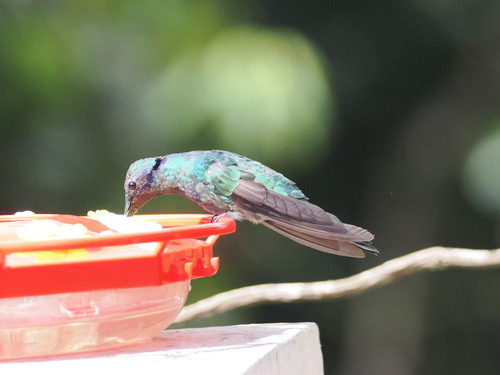


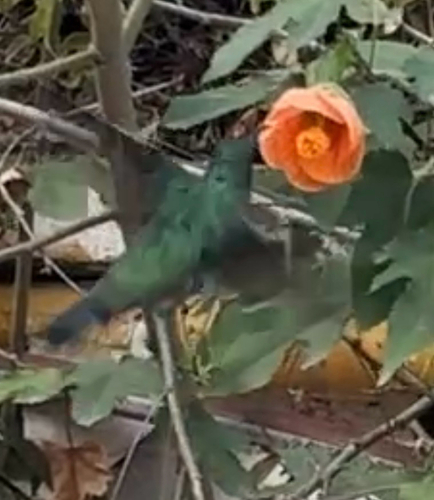
What the Sparkling Violetear sounds like


ID tip
The sparkling violetear is the largest violetear at 13 to 14 cm (5 to 5.5 in) long. Male birds weigh 5.8 to 8.5 g (0.20 to 0.30 oz) and females 6 to 7.5 g (0.21 to 0.26 oz). The nominate male's upperparts are metallic bluish green, the chin bluish violet, the belly blue, and the rest of the underparts green. Long erectile bluish violet plumes cover the ears. The tail is metallic green with a steely blue band near the end. Females are similar but smaller, and often have a white spot behind the eye. C. c. Voice: The sparkling violetear is very vocal. Its principal song is "a long series of monosyllabic metallic chips, 'djit...djit...djit...' or 'tlik...tlik...tlik..'." It also sings "a medley of chips, squeals, gurgling sounds and short warbles" during aerial display. Its call is "a repeated short dry rattle 'drrr...drrr...'."
Text from Wikipedia, licensed CC BY-SA 4.0.
When to see the Sparkling Violetear
One bar for each month, and every month is filled: this bird is recorded here in all twelve. The wide bar is October, the month with the most records.
Where to see the Sparkling Violetear
The map shades 7 countries with regular records, and 1 more in a lighter tone where the bird turns up only as a stray. Everything unshaded has no records. Countries are listed below the map.
Recorded as a rare visitor in Guyana.
About the Sparkling Violetear
The sparkling violetear is a species of hummingbird widespread in highlands of northern and western South America, including a large part of the Andes, the Venezuelan Coastal Range, and the Tepuis. It occurs in a wide range of semi-open habitats, even in gardens and parks within major cities such as Quito, and is often the most common species of hummingbird in its range. It is highly vocal and territorial.
Text adapted from Wikipedia, licensed CC BY-SA 4.0.
Easily confused with
 Lesser VioletearColibri cyanotusThe lesser violetear is roughly medium-sized by hummingbird standards.
 Brown VioletearColibri delphinaeThe brown violetear is a large hummingbird that breeds at middle elevations in the mountains in Central America, and western and northern South America with isolated populations on Trinidad and in the Brazilian state Bahia.
 Mexican VioletearColibri thalassinusThe Mexican violetear is roughly medium-sized by hummingbird standards.
Side by side: Lesser Violetear vs Sparkling Violetear · Mexican Violetear vs Sparkling Violetear
Learn the Sparkling Violetear in the BeakBrain App
Photo and call practice. Coming soon to iPhone and Android.
Play today's Daily BirdEvery photo and recording on this page is credited to its author under the licence shown. Spotted a problem with this page, or have a better photo? Contribute.