Learn what every symbol on the card means.Full credits and sources at beakbrain.com/symbols
 ForestCup nestTiny · 11 g


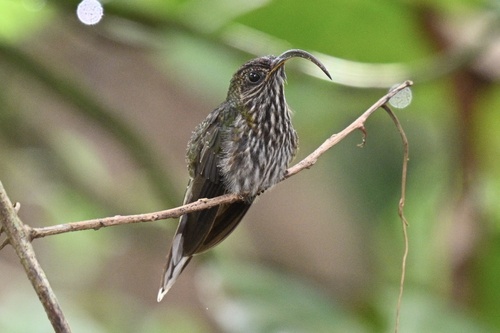
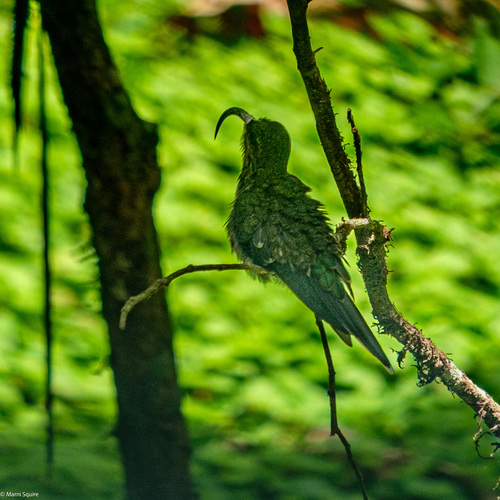
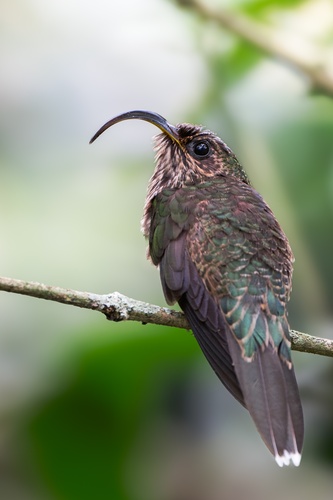

What the White-tipped Sicklebill sounds like

ID tip
The white-tipped sicklebill's most prominent feature is its strongly decurved bill that arcs through a quarter circle; the maxilla is jello and the mandible yellow. The species is about 11.5 to 13.5 cm (4.5 to 5.3 in) long and weighs about 8.6 to 14.5 g (0.30 to 0.51 oz). The sexes are alike in plumage. Adults' upperparts are green, their throat and chest blackish, and the rest of the underparts striped green and white. The tail is mostly green, with the outer pair of feathers more dusky with white tips. Juveniles appear scaly. Voice: The white-tipped sicklebill's song is "a complex series of thin, whiny squeaks followed by some strident, high, tseep notes." There appears to be some geographic variation in it. One description of its call is "high, thin, sharp piercing tsitting notes".
Text from Wikipedia, licensed CC BY-SA 4.0.
When to see the White-tipped Sicklebill
One bar for each month, and every month is filled: this bird is recorded here in all twelve. The wide bar is March, the month with the most records.
Where to see the White-tipped Sicklebill
The map shades 5 countries with regular records. Everything unshaded has no records. Countries are listed below the map.
About the White-tipped Sicklebill
The white-tipped sicklebill is a species of hummingbird in the family Trochilidae. It is found in Colombia, Costa Rica, Ecuador, Panama, Peru, and Venezuela.
Text adapted from Wikipedia, licensed CC BY-SA 4.0.
Easily confused with

Learn the White-tipped Sicklebill in the BeakBrain App
Photo and call practice. Coming soon to iPhone and Android.
Play today's Daily BirdEvery photo and recording on this page is credited to its author under the licence shown. Spotted a problem with this page, or have a better photo? Contribute.