Learn what every symbol on the card means.Full credits and sources at beakbrain.com/symbols
 ForestCup nestTiny · 11 g

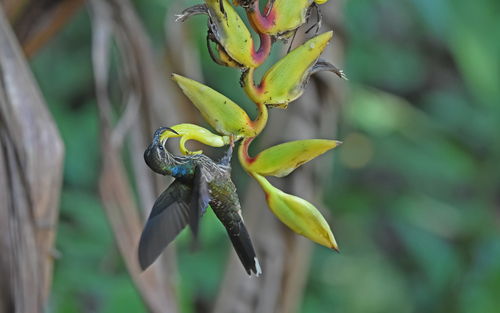
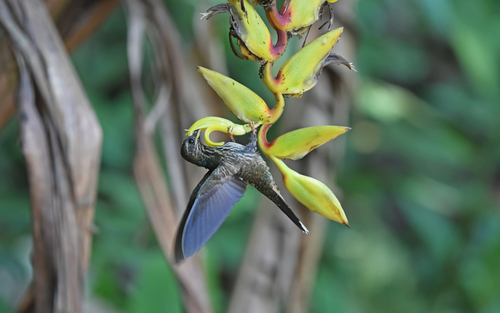
ID tip
With a total length of 5–6 in (13–15 cm) and weighing 0.28–0.44 oz (7.9–12.5 g), it is a relatively large hummingbird. Males and females are virtually identical, differing only in size (especially wing measurements), with the females being some 20% smaller. Its upperparts are iridescent dull greenish, while the underparts are whitish, densely streaked with dusky. The neck-side has a relatively faint blue patch. The tips of the rectrices (tail feathers) are white, and there is a naked stripe on top of the head (but this is usually concealed).
Text from Wikipedia, licensed CC BY-SA 4.0.
When to see the Buff-tailed Sicklebill
One bar for each month. Filled bars are the 10 months with records; pale bars are months with none. The wide bar is October, the month with the most records.
Where to see the Buff-tailed Sicklebill
The map shades 3 countries with regular records. Everything unshaded has no records. Countries are listed below the map.
About the Buff-tailed Sicklebill
The buff-tailed sicklebill is a species of hermit hummingbird from the lower Andes and adjacent west Amazonian lowlands from southern Colombia and northern Ecuador to Peru and Bolivia.
Text adapted from Wikipedia, licensed CC BY-SA 4.0.
Easily confused with

Learn the Buff-tailed Sicklebill in the BeakBrain App
Photo and call practice. Coming soon to iPhone and Android.
Play today's Daily BirdEvery photo and recording on this page is credited to its author under the licence shown. Spotted a problem with this page, or have a better photo? Contribute.