Learn what every symbol on the card means.Full credits and sources at beakbrain.com/symbols
 ShrublandCavity nestSmall · 22 g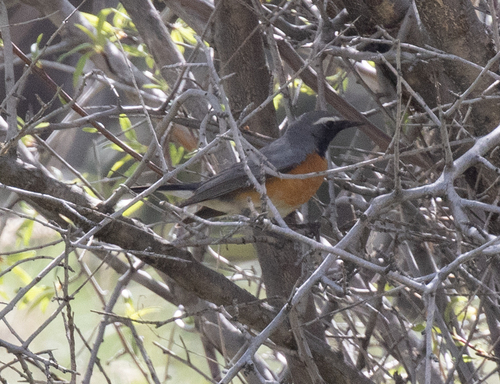


What the White-throated Robin sounds like


ID tip
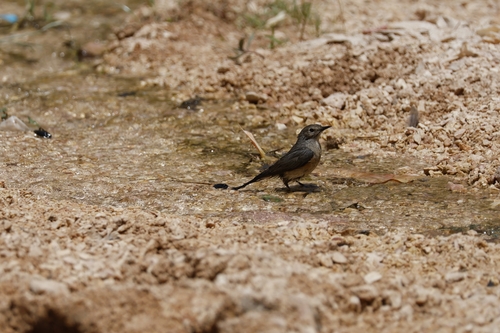
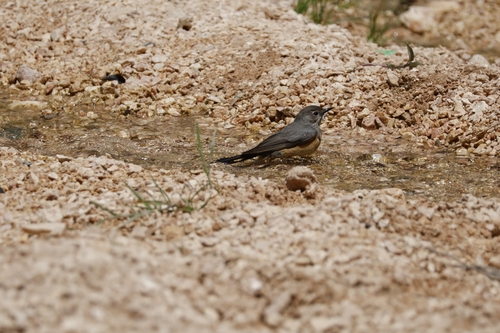
This species is larger than the European robin, having a length of 16 centimetres (6.3 in) and a wingspan of 28 centimetres (11 in). The breeding male has lead-grey upperparts, a black face with a white throat and supercilium, and orange underparts. The tail is black, as is the strong bill. Females are plainer, mainly grey apart from a black tail, hints of orange on the flanks, and some white throat streaks. The male's song is a fast twittering, given from a bush or in flight. The call of this species is a chis-it double note, like that of the white wagtail.
Text from Wikipedia, licensed CC BY-SA 4.0.
When to see the White-throated Robin
One bar for each month. Filled bars are the 6 months with records; pale bars are months with none. The wide bar is May, the month with the most records.
Where to see the White-throated Robin
The map shades 26 countries with regular records, and 4 more in a lighter tone where the bird turns up only as a stray. Everything unshaded has no records. Countries are listed below the map.
Recorded as a rare visitor in Sweden, United Kingdom, Somalia, Norway.
About the White-throated Robin
The white-throated robin or irania is a small, migratory passerine bird in the Old World flycatcher family Muscicapidae, and the only member of the genus Irania. It breeds on high-altitude mountain slopes with dense scrub in western Asia and winters in East Africa. Males have lead-grey upperparts and bright orange underparts with a namesake white throat patch. Females are duller, with greyer underparts, orange sides, and a fainter white throat compared to the males.
Text adapted from Wikipedia, licensed CC BY-SA 4.0.
Easily confused with
 Buff-streaked ChatCampicoloides bifasciatusThe buff-streaked chat or buff-streaked bushchat is a species of bird in the family Muscicapidae.
 Cyprus WheatearOenanthe cypriacaThe Cyprus wheatear or Cyprus pied wheatear is a small, 14–15 cm long passerine bird that was formerly classed as a member of the thrush family Turdidae, but is now more generally considered to be an Old World flycatcher, Muscicapidae.
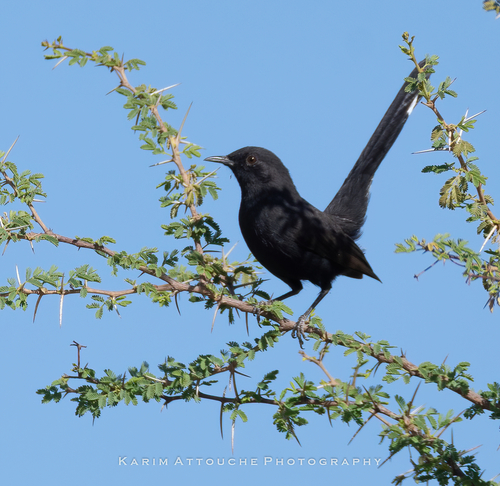 Black Scrub RobinCercotrichas podobeThe black scrub robin is a species of bird in the family Muscicapidae.
Learn the White-throated Robin in the BeakBrain App
Photo and call practice. Coming soon to iPhone and Android.
Play today's Daily BirdEvery photo and recording on this page is credited to its author under the licence shown. Spotted a problem with this page, or have a better photo? Contribute.