Learn what every symbol on the card means.Full credits and sources at beakbrain.com/symbols
 ForestTiny · 4 g


What the White-throated Daggerbill sounds like

ID tip
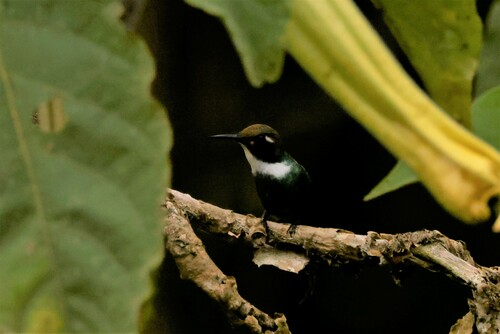
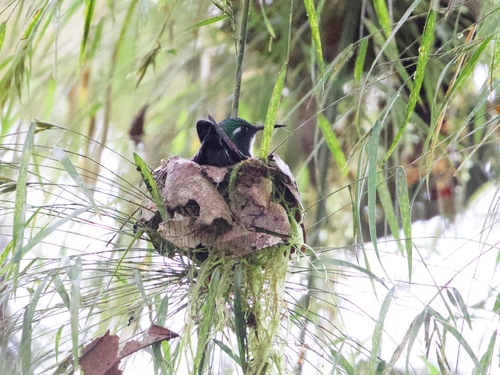
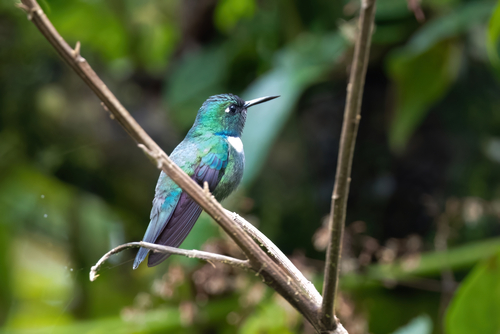
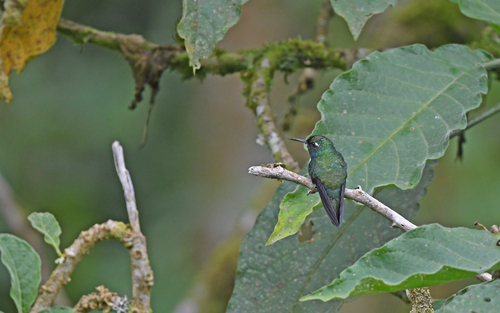
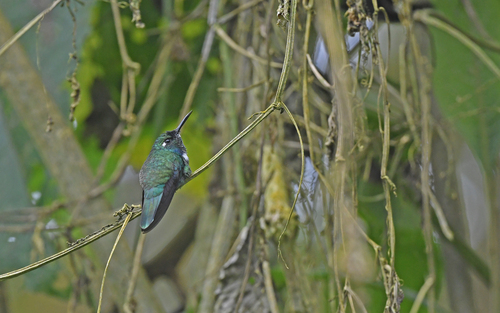
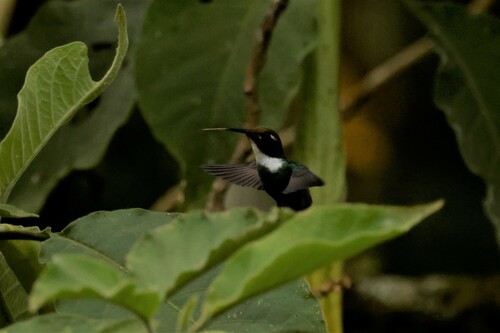
The white-throated daggerbill is 8.6 to 9.3 cm (3.4 to 3.7 in) long and weighs 3.5 to 4.1 g (0.12 to 0.14 oz). It gets its name from the tip of its bill, which is very narrow and sharply pointed. Both sexes are generally green overall. Males have a shiny green forehead, violet-blue patches on the sides of the throat that can extend well up into the face, a white band across the upper chest, and a small white patch behind the eye. Females' foreheads are not shiny, the throat patches are smaller and mostly blue, and they have an unmarked white throat. Voice: The white-throated daggerbill's song is "a series of two different high-pitched notes repeated, 'tsit...seet...tsit...seet...', at an irregular pace".
Text from Wikipedia, licensed CC BY-SA 4.0.
When to see the White-throated Daggerbill
One bar for each month, and every month is filled: this bird is recorded here in all twelve. The wide bar is November, the month with the most records.
Where to see the White-throated Daggerbill
The map shades 2 countries with regular records. Everything unshaded has no records. Countries are listed below the map.
About the White-throated Daggerbill
The white-throated daggerbill, white-throated wedgebill, or western wedge-billed hummingbird is a species of hummingbird in the family Trochilidae. It is found in Colombia and Ecuador.
Text adapted from Wikipedia, licensed CC BY-SA 4.0.
Easily confused with

Learn the White-throated Daggerbill in the BeakBrain App
Photo and call practice. Coming soon to iPhone and Android.
Play today's Daily BirdEvery photo and recording on this page is credited to its author under the licence shown. Spotted a problem with this page, or have a better photo? Contribute.