Learn what every symbol on the card means.Full credits and sources at beakbrain.com/symbols
 ForestCup nestTiny · 4 g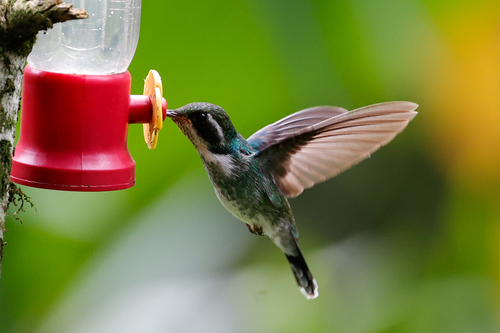


What the Geoffroy's Daggerbill sounds like

ID tip
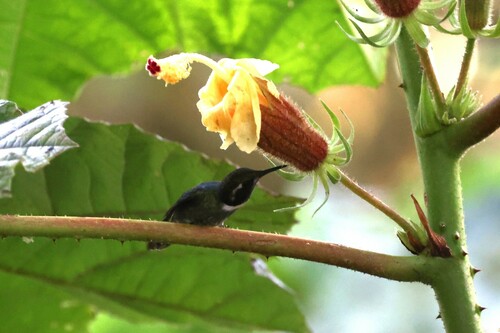
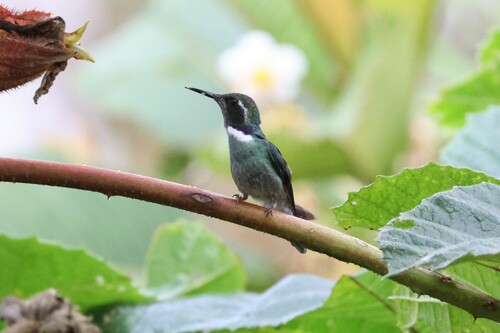
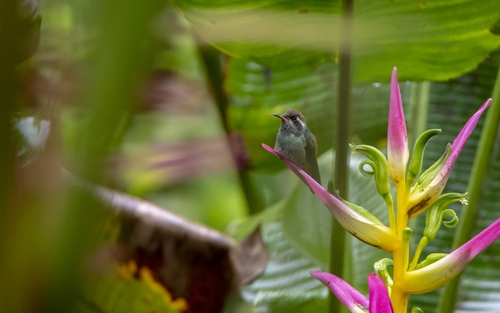
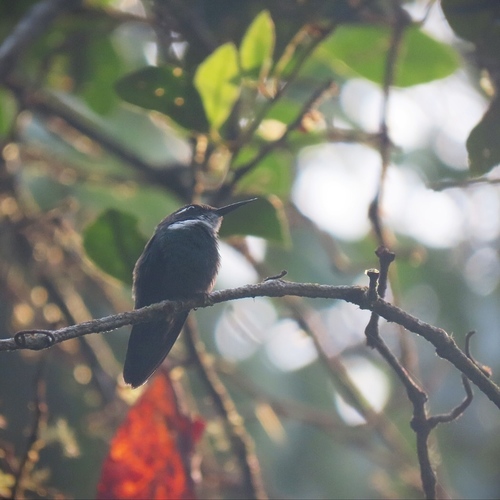
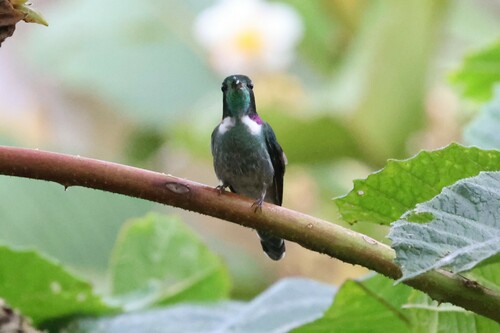
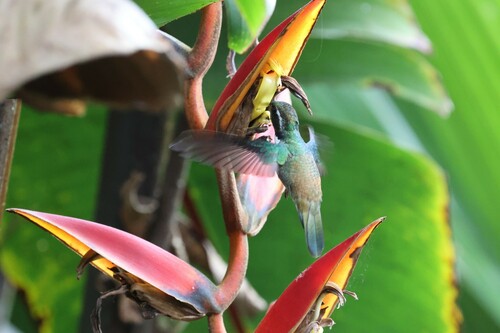
Geoffroy's daggerbill is 8.6 to 9.3 cm (3.4 to 3.7 in) long and weighs 3.5 to 4.1 g (0.12 to 0.14 oz). It gets its name from the tip of its bill, which is very narrow and sharply pointed, though this characteristic is not easily seen in the field. Males of the nominate subspecies have bronzy green upperparts with a coppery cast to the rump. They have glittery violet patches on the sides of the iridescent golden-green throat, white patches on either side of the upper chest, and an elongated white patch behind the eye. Their underpars are green. Voice: The song of Geoffroy's daggerbill is "an insect-like series of regularly spaced simple 'tsit' or sibilant 'sink' notes." It is sung from a low perch.
Text from Wikipedia, licensed CC BY-SA 4.0.
When to see the Geoffroy's Daggerbill
One bar for each month, and every month is filled: this bird is recorded here in all twelve. The wide bar is October, the month with the most records.
Where to see the Geoffroy's Daggerbill
The map shades 5 countries with regular records. Everything unshaded has no records. Countries are listed below the map.
About the Geoffroy's Daggerbill
Geoffroy's daggerbill, Geoffroy's wedgebill, or eastern wedge-billed hummingbird is a species of hummingbird in the family Trochilidae. It is found in Bolivia, Colombia, Ecuador, Peru, and Venezuela.
Text adapted from Wikipedia, licensed CC BY-SA 4.0.
Easily confused with

Learn the Geoffroy's Daggerbill in the BeakBrain App
Photo and call practice. Coming soon to iPhone and Android.
Play today's Daily BirdEvery photo and recording on this page is credited to its author under the licence shown. Spotted a problem with this page, or have a better photo? Contribute.