Learn what every symbol on the card means.Full credits and sources at beakbrain.com/symbols
 ForestCavity nestMedium · 90 g


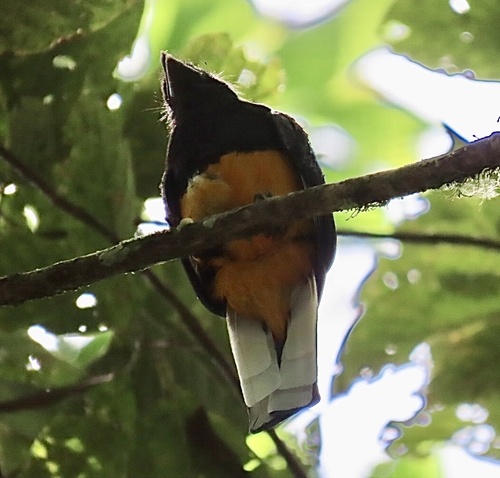
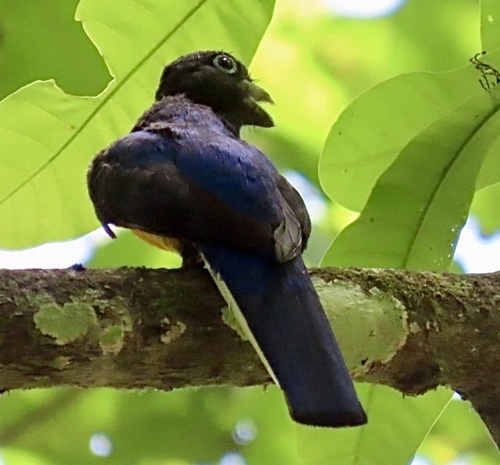


What the White-tailed Trogon sounds like


ID tip
This relatively large trogon is 28 to 30 centimetres (11 to 12 in) long. As most trogons, it is strongly sexually dimorphic. In the male the head and upper breast are dark blue (appears blackish in poor light), and the back is green, becoming bluer on the rump. The lower underparts are orange-yellow. The wings are black, vermiculated with white. The undertail is almost entirely white with only a very narrow black base to each feather. The complete eye-ring is pale bluish.
Text from Wikipedia, licensed CC BY-SA 4.0.
When to see the White-tailed Trogon
One bar for each month, and every month is filled: this bird is recorded here in all twelve. The wide bar is February, the month with the most records.
Where to see the White-tailed Trogon
The map shades 3 countries with regular records. Everything unshaded has no records. Countries are listed below the map.
About the White-tailed Trogon
The white-tailed trogon is a species of bird in the trogon family. It is found in tropical humid forests of the Chocó, ranging from Panama, through western Colombia, to western Ecuador. It was formerly considered a subspecies of T. viridis, which is widespread in South America east of the Andes, but under the English name white-tailed trogon.
Text adapted from Wikipedia, licensed CC BY-SA 4.0.
Easily confused with
 Citreoline TrogonTrogon citreolusAround 27 cm in size, weighing between 85 and 90 grams.
 Mountain TrogonTrogon mexicanusThe mountain trogon measures 11.5–12.5 in (29–31.5 cm) in length.
 Baird's TrogonTrogon bairdiiBaird's trogon is 25 to 28 cm (9.8 to 11.0 in) long and weighs about 95 g (3.4 oz).
Side by side: Mountain Trogon vs White-tailed Trogon · Citreoline Trogon vs White-tailed Trogon · Baird's Trogon vs White-tailed Trogon
Learn the White-tailed Trogon in the BeakBrain App
Photo and call practice. Coming soon to iPhone and Android.
Play today's Daily BirdEvery photo and recording on this page is credited to its author under the licence shown. Spotted a problem with this page, or have a better photo? Contribute.