Learn what every symbol on the card means.Full credits and sources at beakbrain.com/symbols
 WoodlandCavity nestMedium · 79 g



ID tip
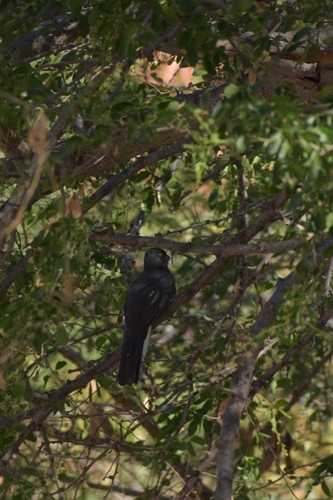
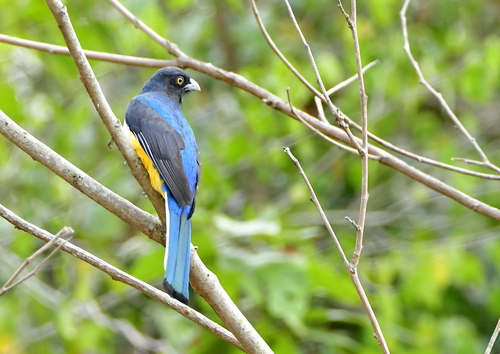
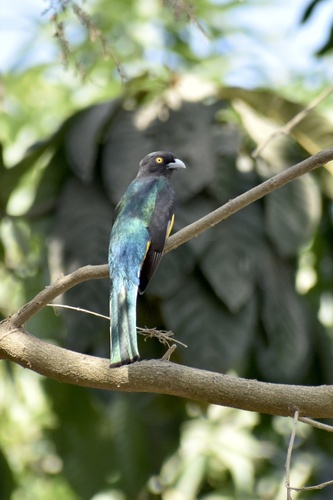
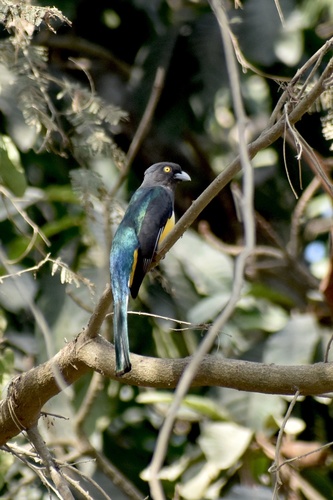
Around 27 cm in size, weighing between 85 and 90 grams. Adult males have a uniform gray head and upper breast and a metallic green mantle, fading to a violet-blue rump. The bill is pale blue-grey, and the eyes are yellow. The uppertail is blue-green with a black tip, and the wings are dark, with outer webs of the primaries white. The dark gray upper breast is separated from the bright yellow belly and undertail, with a creamy white breastband. Females are entirely dark gray above and tend to have a paler gray breast and paler yellow belly.
Text from Wikipedia, licensed CC BY-SA 4.0.
When to see the Citreoline Trogon
One bar for each month. Filled bars are the 10 months with records; pale bars are months with none. The wide bar is March, the month with the most records.
Where to see the Citreoline Trogon
The map shades 1 country with regular records. Everything unshaded has no records. Countries are listed below the map.
About the Citreoline Trogon
The citreoline trogon is a species of bird in the family Trogonidae. It is endemic to western Mexico, with an estimated distribution size of 539,000 km2 Due to this very large range, the IUCN consider it a species of Least Concern and that the current population trend is stable. T. citreolus has also been studied as an Ecosystem engineer.
Text adapted from Wikipedia, licensed CC BY-SA 4.0.
Easily confused with
 Mountain TrogonTrogon mexicanusThe mountain trogon measures 11.5–12.5 in (29–31.5 cm) in length.
 White-tailed TrogonTrogon chionurusThis relatively large trogon is 28 to 30 centimetres (11 to 12 in) long.
 Blue-crowned TrogonTrogon curucuiThe blue-crowned trogon is about 24 cm (9.4 in) long and weighs 39 to 63 g (1.4 to 2.2 oz).
Side by side: Blue-crowned Trogon vs Citreoline Trogon · Citreoline Trogon vs Mountain Trogon · Citreoline Trogon vs White-tailed Trogon
Learn the Citreoline Trogon in the BeakBrain App
Photo and call practice. Coming soon to iPhone and Android.
Play today's Daily BirdEvery photo and recording on this page is credited to its author under the licence shown. Spotted a problem with this page, or have a better photo? Contribute.