Learn what every symbol on the card means.Full credits and sources at beakbrain.com/symbols
 ForestCup nestSmall · 19 g


What the White-plumed Honeyeater sounds like


ID tip
Similar in appearance to the Yellow-plumed, Yellow-tinted, Fuscous and Grey-fronted Honeyeaters, the distinguishing feature of the White-plumed honeyeater is the distil white bands at its neck called neck-plumes. This is where its name is derived from with the species epithet penicillata deriving from the Modern Latin penicillatus meaning tufted or with brush-like tufts originating from the Latin word penicillus meaning a painter's brush. It is a medium-sized honeyeater with a yellowish head, pale grey-brown plumage below and yellowish-olive feathers on its back. Voice: Consist of a variety of songs depending on locality as well as chip calls, described as a sharp, shrill descending chip noise, whistles, twittering (when congregated) and alarm calls which again vary depending on region. Tend to be the most vocal in July through to August in the South, and most vocal in the afternoons.
Text from Wikipedia, licensed CC BY-SA 4.0.
When to see the White-plumed Honeyeater
One bar for each month, and every month is filled: this bird is recorded here in all twelve. The wide bar is October, the month with the most records.
Where to see the White-plumed Honeyeater
The map shades 1 country with regular records. Everything unshaded has no records. Countries are listed below the map.
About the White-plumed Honeyeater
The white-plumed honeyeater is a medium sized passerine of the family Meliphagidae (honeyeaters) endemic to mainland Australia. Its key identifying characteristics are a primarily olive-grey body and yellow face, a slightly down-curved bill and its white distal neck-plumes from which it takes its name. White-Plumed Honeyeaters exhibit a preference for woodlands and riparian areas and have a very strong association with River Red Gums. They exhibit a small seasonal migration from ranges to lower areas in winter. Today the species is most commonly seen through Victoria, South Australia and New South Wales, but is also found in regions of Western Australia and the Northern Territory.
Text adapted from Wikipedia, licensed CC BY-SA 4.0.
Easily confused with
 Fuscous HoneyeaterPtilotula fuscaThe fuscous honeyeater is dull grey-brown to olive-brown above with buffy-grey underparts.
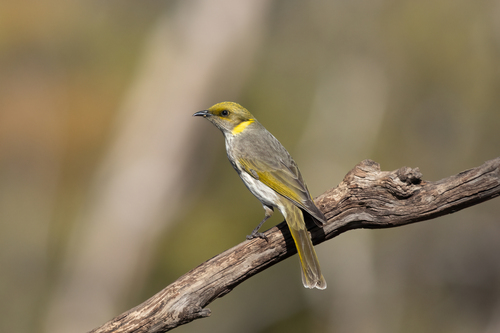 Yellow-plumed HoneyeaterPtilotula ornataThe yellow-plumed honeyeater is a medium-sized honeyeater with a relatively long, down-curved black bill, a dark face and a distinctive, upswept yellow neck plume.
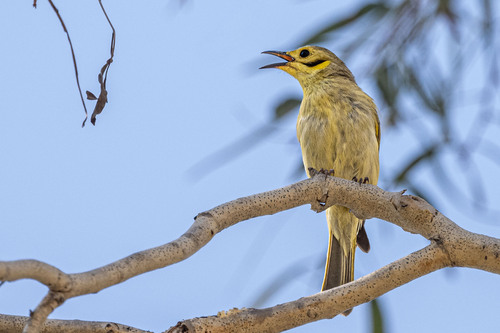 Yellow-tinted HoneyeaterPtilotula flavescensThe yellow-tinted honeyeater is a species of bird in the family Meliphagidae.
Side by side: Fuscous Honeyeater vs White-plumed Honeyeater · White-plumed Honeyeater vs Yellow-plumed Honeyeater
Learn the White-plumed Honeyeater in the BeakBrain App
Photo and call practice. Coming soon to iPhone and Android.
Play today's Daily BirdEvery photo and recording on this page is credited to its author under the licence shown. Spotted a problem with this page, or have a better photo? Contribute.