Learn what every symbol on the card means.Full credits and sources at beakbrain.com/symbols
 ForestLarge · 312 g


ID tip
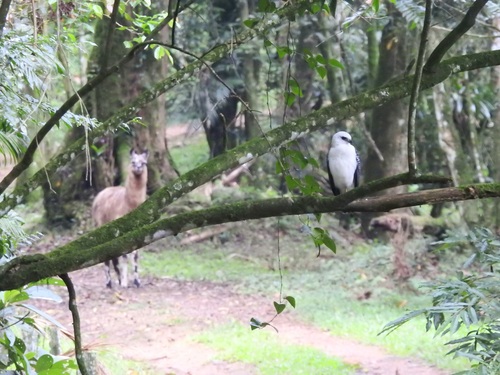
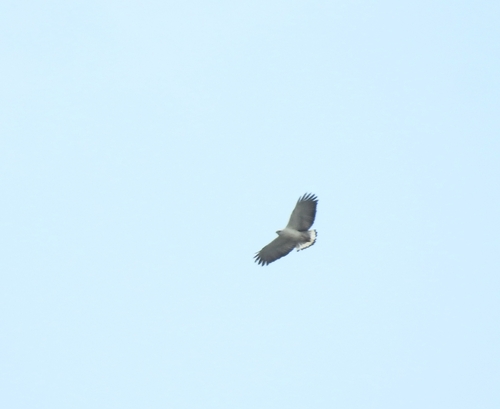
The white-necked hawk is 43 to 48 cm (17 to 19 in) long with a 91 to 101 cm (36 to 40 in) wingspan. Males and females have the same plumage, though females are about 4% larger than males. Adults have a white head and underparts and black upperparts. Their tail is black with a wide white band in the middle. Their eye is brown or pale yellow and their legs and feed yellow. Immatures are similar to adults but with dark streaks on their crown and neck, brown tips on some upperparts feathers, and white barring on the black base of their tail. Voice: As of late 2022 xeno-canto had only one recording of a white-necked hawk and the Cornell Lab of Ornithology's Macaulay Library had three. Its vocalizations have not been transcribed.
Text from Wikipedia, licensed CC BY-SA 4.0.
When to see the White-necked Hawk
One bar for each month. Filled bars are the 11 months with records; pale bars are months with none. The wide bar is October, the month with the most records.
Where to see the White-necked Hawk
The map shades 1 country with regular records. Everything unshaded has no records. Countries are listed below the map.
About the White-necked Hawk
The white-necked hawk is a Vulnerable species of bird of prey in the subfamily Accipitrinae, the "true" hawks, of family Accipitridae. It is endemic to Brazil.
Text adapted from Wikipedia, licensed CC BY-SA 4.0.
Easily confused with
 Rufous Crab HawkButeogallus aequinoctialisThe rufous crab hawk is 42.5 to 46 cm (17 to 18 in) in overall length with a 90 to 106 cm (35 to 42 in) wingspan.
 Solitary EagleButeogallus solitariusThe adult solitary eagle is uniformly dark gray, often appearing black, with white markings on the tail.
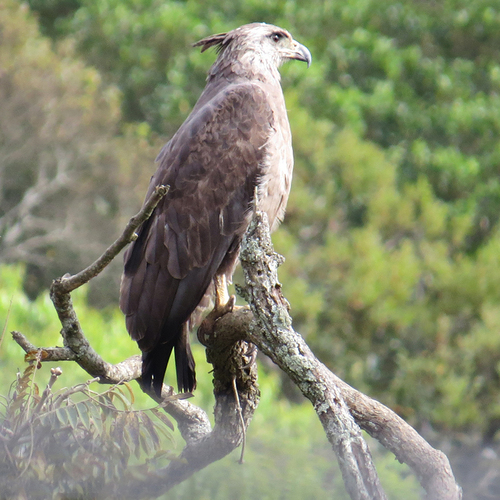 Chaco EagleButeogallus coronatusThe Chaco eagle is a large raptor with a mostly dull and silvery grey body plumage.
Learn the White-necked Hawk in the BeakBrain App
Photo and call practice. Coming soon to iPhone and Android.
Play today's Daily BirdEvery photo and recording on this page is credited to its author under the licence shown. Spotted a problem with this page, or have a better photo? Contribute.