Learn what every symbol on the card means.Full credits and sources at beakbrain.com/symbols
 ForestPlatform nestHuge · 3.0 kg


What the Solitary Eagle sounds like

ID tip
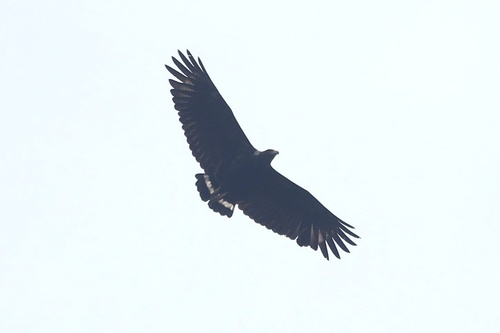
The adult solitary eagle is uniformly dark gray, often appearing black, with white markings on the tail. It is 63 to 79 cm (25 to 31 in) and has a 152 to 188 cm (5 ft 0 in to 6 ft 2 in) wingspan. With a body mass of approximately 3 kg (6.6 lb), it appears to rival its similarly-weighted sister species, the Chaco eagle, as one of the larger living members of the Buteoninae subfamily, although the black-chested buzzard-eagle is similar or only marginally smaller in weight, while large Milvini from the genus Haliaeetus and Icthyophaga (such as the Steller's sea eagle) can be significantly larger.
Text from Wikipedia, licensed CC BY-SA 4.0.
When to see the Solitary Eagle
One bar for each month, and every month is filled: this bird is recorded here in all twelve. The wide bar is October, the month with the most records.
Where to see the Solitary Eagle
The map shades 10 countries with regular records, and 4 more in a lighter tone where the bird turns up only as a stray. Everything unshaded has no records. Countries are listed below the map.
Recorded as a rare visitor in Costa Rica, Brazil, French Guiana, Guatemala.
About the Solitary Eagle
The solitary eagle or montane solitary eagle is a large Neotropical eagle. It is also known as the black solitary eagle.
Text adapted from Wikipedia, licensed CC BY-SA 4.0.
Easily confused with
 Rufous Crab HawkButeogallus aequinoctialisThe rufous crab hawk is 42.5 to 46 cm (17 to 18 in) in overall length with a 90 to 106 cm (35 to 42 in) wingspan.
 White-necked HawkButeogallus lacernulatusThe white-necked hawk is 43 to 48 cm (17 to 19 in) long with a 91 to 101 cm (36 to 40 in) wingspan.
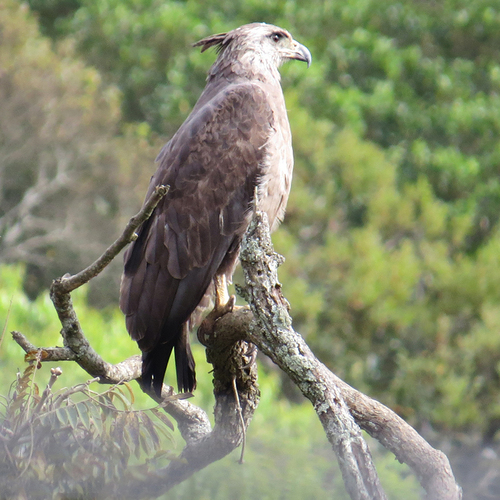 Chaco EagleButeogallus coronatusThe Chaco eagle is a large raptor with a mostly dull and silvery grey body plumage.
Learn the Solitary Eagle in the BeakBrain App
Photo and call practice. Coming soon to iPhone and Android.
Play today's Daily BirdEvery photo and recording on this page is credited to its author under the licence shown. Spotted a problem with this page, or have a better photo? Contribute.