Learn what every symbol on the card means.Full credits and sources at beakbrain.com/symbols
 WoodlandPlatform nestLarge · 325 g


ID tip
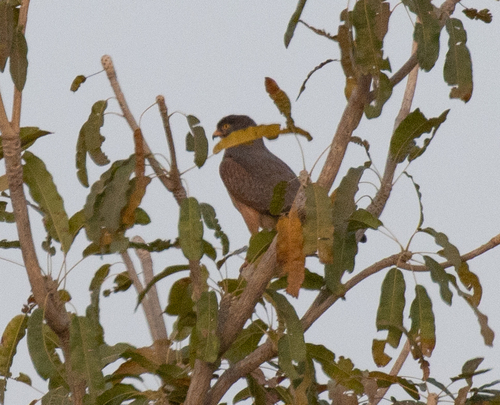
This slim and small hawk is easily identified by its white iris and the white throat and dark mesial stripe. A white spot is sometimes visible on the back of the head. When perched, the wing tip nearly reaches the tip of the tail. The ceres are distinctly yellow and the head is dark with the underside of the body darkly barred. In flight, the narrow wings appear rounded with black tips to the feathers and the wing lining appears dark. The upper wing in flight shows a pale bar over the brown. The rufous tail is barred with a darker subterminal band.
Text from Wikipedia, licensed CC BY-SA 4.0.
When to see the White-eyed Buzzard
One bar for each month. Filled bars are the 11 months with records; pale bars are months with none. The wide bar is February, the month with the most records.
Where to see the White-eyed Buzzard
The map shades 7 countries with regular records, and 1 more in a lighter tone where the bird turns up only as a stray. Everything unshaded has no records. Countries are listed below the map.
Recorded as a rare visitor in Thailand.
About the White-eyed Buzzard
The white-eyed buzzard is a medium-sized hawk, distinct from the true buzzards in the genus Buteo, found in South Asia. Adults have a rufous tail, a distinctive white iris, and a white throat bearing a dark mesial stripe bordered. The head is brown and the median coverts of the upper wing are pale. They lack the typical carpal patches on the underside of the wings seen in true buzzards, but the entire wing lining appears dark in contrast to the flight feathers. They sit upright on perches for prolonged periods and soar on thermals in search of insect and small vertebrate prey. They are vociferous in the breeding season, and several birds may be heard calling as they soar together.
Text adapted from Wikipedia, licensed CC BY-SA 4.0.
Easily confused with
 Grey-faced BuzzardButastur indicusThe males and females of the grey faced buzzard are the same in coloration.
 Rufous-winged BuzzardButastur liventerThe rufous-winged buzzard is an Asian bird of prey.
 Grasshopper BuzzardButastur rufipennisThe adult grasshopper buzzard is grey brown above with a darker head and dark shaft streaks on all of its feathers.
Side by side: Grey-faced Buzzard vs White-eyed Buzzard · Grasshopper Buzzard vs White-eyed Buzzard
Learn the White-eyed Buzzard in the BeakBrain App
Photo and call practice. Coming soon to iPhone and Android.
Play today's Daily BirdEvery photo and recording on this page is credited to its author under the licence shown. Spotted a problem with this page, or have a better photo? Contribute.