Learn what every symbol on the card means.Full credits and sources at beakbrain.com/symbols
 WetlandPlatform nestLarge · 490 g




ID tip
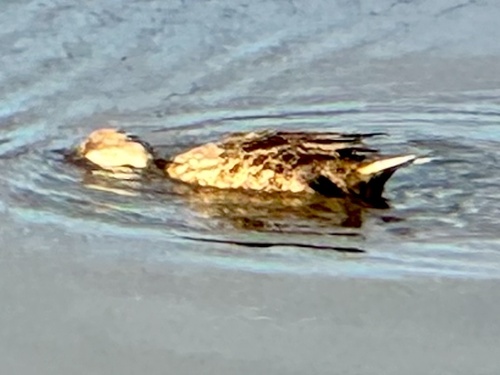
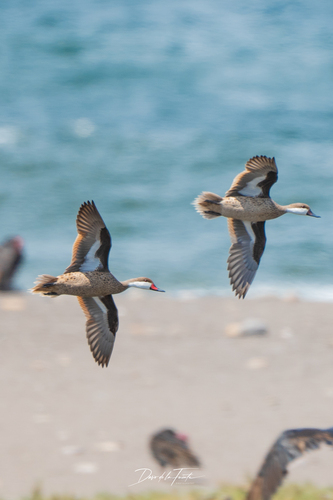
Like many southern ducks, the sexes are similar, though females are slightly smaller and duller in plumage. It is mainly brown with white cheeks and a red-based grey bill; juveniles have duller bill. The wing has an iridescent green speculum. Like the other pintails, it has a slender, acutely pointed tail, though not so marked as in the northern pintail A. acuta. It cannot be confused with any other duck in its range.
Text from Wikipedia, licensed CC BY-SA 4.0.
When to see the White-cheeked Pintail
One bar for each month, and every month is filled: this bird is recorded here in all twelve. The wide bar is October, the month with the most records.
Where to see the White-cheeked Pintail
The map shades 43 countries with regular records, and 10 more in a lighter tone where the bird turns up only as a stray. Everything unshaded has no records. Countries are listed below the map.
Recorded as a rare visitor in United States, Belgium, Sweden, United Kingdom, Portugal, Norway, Netherlands, Canada, Ireland, Croatia.
About the White-cheeked Pintail
The white-cheeked pintail, also known as the Bahama pintail, Bahama duck, or Galápagos duck is a species of dabbling duck that is patchily distributed throughout South America and the Caribbean. It was first described by Carl Linnaeus in his landmark 1758 10th edition of Systema Naturae under its current scientific name.
Text adapted from Wikipedia, licensed CC BY-SA 4.0.
Easily confused with
 Red-billed TealAnas erythrorhynchaThe red-billed teal is 43–48 cm (17–19 in) long and has a blackish cap and nape, contrasting pale face, and bright red bill.
 Mexican DuckAnas diaziThe bird has a length of 45–55 cm (17.7–21.6 in) and a weight of 849–1,243 g (1.872–2.740 lb)
The Mexican duck is mainly brown, with a blue speculum edged with white, obvious in flight or at rest.
Mexican DuckAnas diaziThe bird has a length of 45–55 cm (17.7–21.6 in) and a weight of 849–1,243 g (1.872–2.740 lb)
The Mexican duck is mainly brown, with a blue speculum edged with white, obvious in flight or at rest.
 African Black DuckAnas sparsaThe African black duck is a black duck with pronounced white marks on its back, a dark bill, and orange legs and feet.
Side by side: Mexican Duck vs White-cheeked Pintail · Red-billed Teal vs White-cheeked Pintail · African Black Duck vs White-cheeked Pintail
Learn the White-cheeked Pintail in the BeakBrain App
Photo and call practice. Coming soon to iPhone and Android.
Play today's Daily BirdEvery photo and recording on this page is credited to its author under the licence shown. Spotted a problem with this page, or have a better photo? Contribute.