Learn what every symbol on the card means.Full credits and sources at beakbrain.com/symbols
 WoodlandCup nestSmall · 28 g


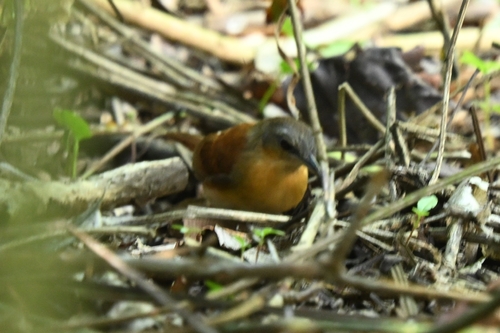
ID tip
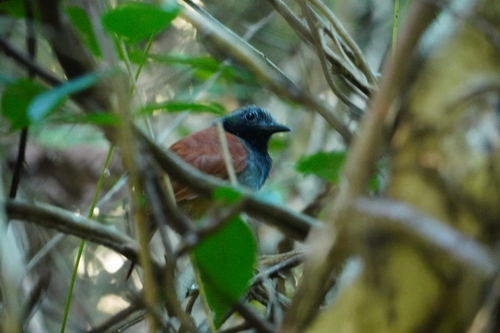
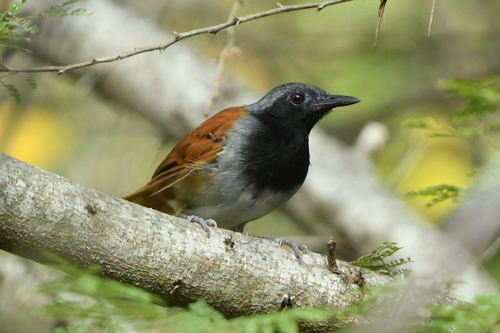
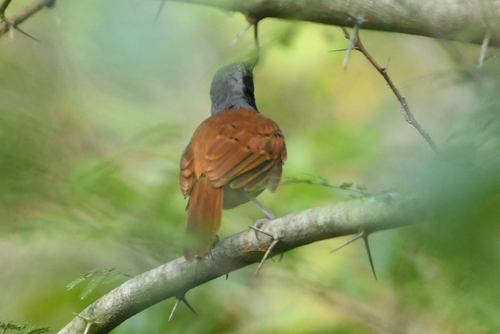
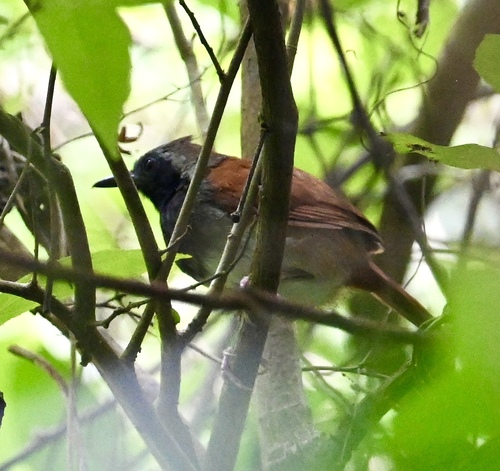
The white-bellied antbird is about 15 cm (5.9 in) long and weighs an average of about 28 g (0.99 oz). Adult males of the nominate subspecies M. l. longipes have a cinnamon rufous crown, upperparts, wings, and tail. They have a hidden white patch between their scapulars. Their lesser wing coverts have white or pale buff edges and sometimes cinnamon tips. The sides of their head, their throat, and their upper breast are black and bordered with slate gray. Their lower breast and belly are white, their flanks tawny or buffy, and their undertail coverts tawny. Voice: The male white-bellied antbird's song is "a bright, ringing crescendo of 15-25 loud, rapid jeer notes...descending, trailing off, and ending in a few chew notes on same pitch". Females sing a similar though shorter song. The species' calls include "a short, liquid rattle" and a "long...thin, downslurred whistle, sometimes abbreviated".
Text from Wikipedia, licensed CC BY-SA 4.0.
When to see the White-bellied Antbird
One bar for each month, and every month is filled: this bird is recorded here in all twelve. The wide bar is March, the month with the most records.
Where to see the White-bellied Antbird
The map shades 7 countries with regular records, and 1 more in a lighter tone where the bird turns up only as a stray. Everything unshaded has no records. Countries are listed below the map.
Recorded as a rare visitor in French Guiana.
About the White-bellied Antbird
The white-bellied antbird, is a passerine bird in subfamily Thamnophilinae of family Thamnophilidae, the "typical antbirds". It is found in Panama, on Trinidad, and across northern South America. It is also called Swainson's antcatcher after William Swainson, who first described it scientifically.
Text adapted from Wikipedia, licensed CC BY-SA 4.0.
Easily confused with
 Checker-throated StipplethroatEpinecrophylla fulviventrisThe checker-throated stipplethroat is 10 to 11 cm (3.9 to 4.3 in) long and weighs 8.5 to 11.5 g (0.30 to 0.41 oz).
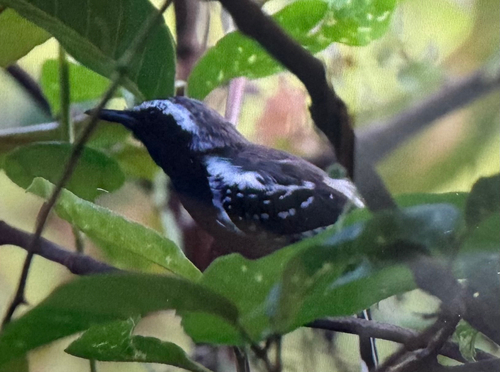 Northern White-fringed AntwrenFormicivora intermediaThe northern white-fringed antwren is 12 to 13 cm (4.7 to 5.1 in) long and weighs 8 to 14 grams (0.28 to 0.49 oz).
 Spot-backed AntshrikeHypoedaleus guttatusThe spot-backed antshrike is a large antbird, 20 to 21 cm (7.9 to 8.3 in) long.
Side by side: Checker-throated Stipplethroat vs White-bellied Antbird · Spot-backed Antshrike vs White-bellied Antbird
Learn the White-bellied Antbird in the BeakBrain App
Photo and call practice. Coming soon to iPhone and Android.
Play today's Daily BirdEvery photo and recording on this page is credited to its author under the licence shown. Spotted a problem with this page, or have a better photo? Contribute.