Learn what every symbol on the card means.Full credits and sources at beakbrain.com/symbols
 ForestSmall · 39 g
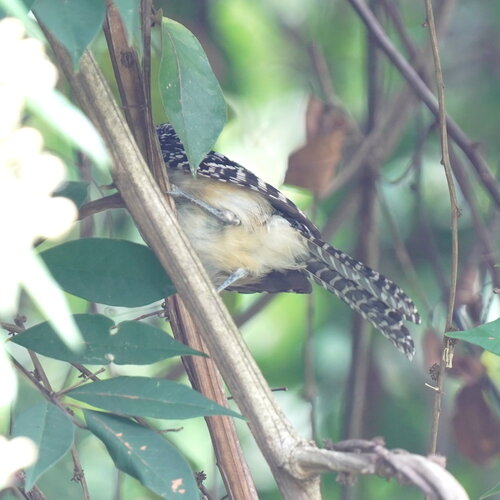
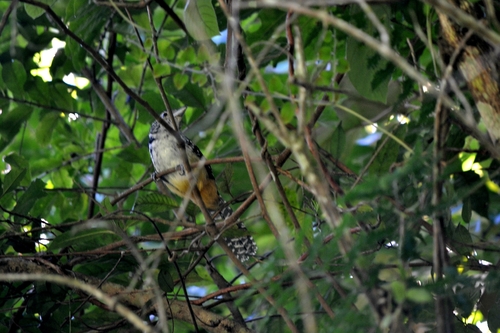
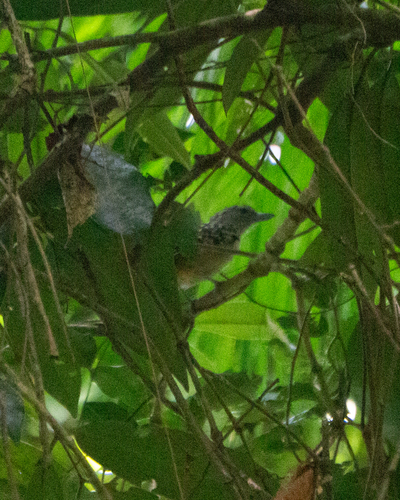
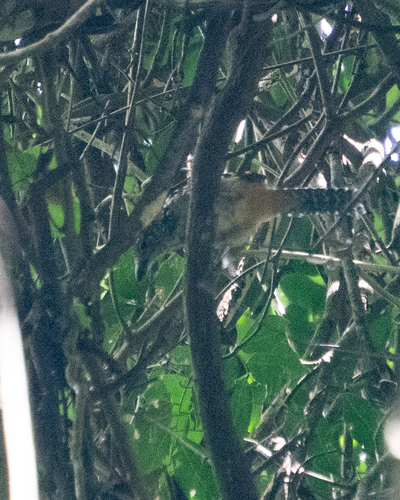
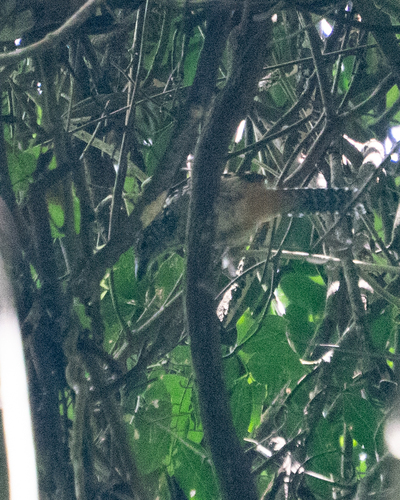
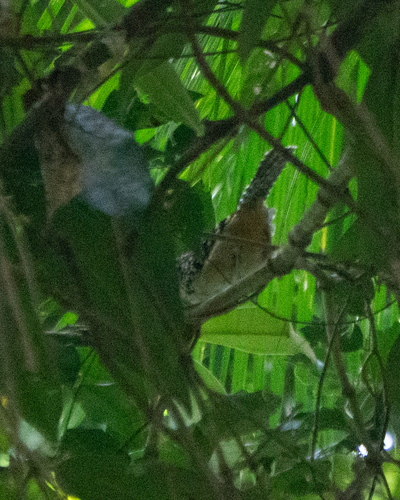
What the Spot-backed Antshrike sounds like

ID tip
The spot-backed antshrike is a large antbird, 20 to 21 cm (7.9 to 8.3 in) long. The species exhibits slight sexual dimorphism. Both sexes have a short, heavy, gray bill with a hook at the end like true shrikes. Adult males have a black crown, nape, and upperparts spotted with white and a brownish black tail with white bars. Their throat and breast are white and their sides pale gray. Their belly and crissum are nearly white in the northern part of their range and gradually darken to brownish yellow to the south. Voice: The spot-backed antshrike's song is a "very high, slow, at first rising then descending, shivering rattle" that lasts four or five seconds. Its calls include a "long, downward-inflected whistle", a "shorter, slightly descending churr", and an "abrupt 'chip' ".
Text from Wikipedia, licensed CC BY-SA 4.0.
When to see the Spot-backed Antshrike
One bar for each month, and every month is filled: this bird is recorded here in all twelve. The wide bar is October, the month with the most records.
Where to see the Spot-backed Antshrike
The map shades 3 countries with regular records. Everything unshaded has no records. Countries are listed below the map.
About the Spot-backed Antshrike
The spot-backed antshrike is a species of bird in subfamily Thamnophilinae of family Thamnophilidae, the "typical antbirds". It is found in Argentina, Brazil, and Paraguay.
Text adapted from Wikipedia, licensed CC BY-SA 4.0.
Easily confused with
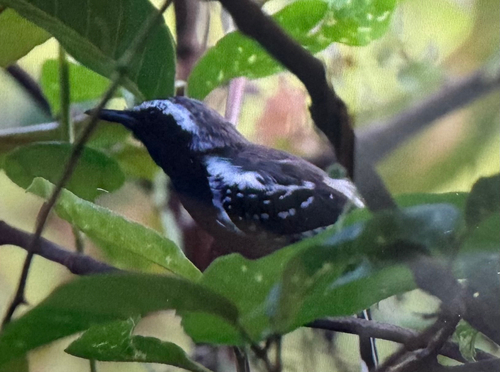 Northern White-fringed AntwrenFormicivora intermediaThe northern white-fringed antwren is 12 to 13 cm (4.7 to 5.1 in) long and weighs 8 to 14 grams (0.28 to 0.49 oz).
 Checker-throated StipplethroatEpinecrophylla fulviventrisThe checker-throated stipplethroat is 10 to 11 cm (3.9 to 4.3 in) long and weighs 8.5 to 11.5 g (0.30 to 0.41 oz).
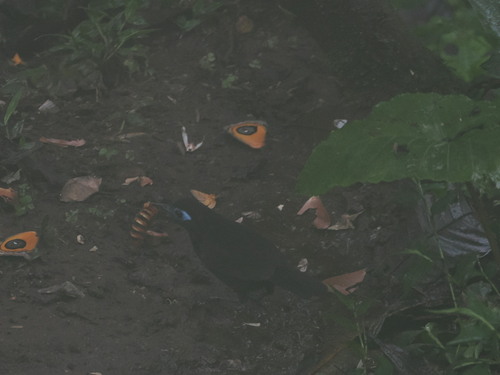 Zeledon's AntbirdHafferia zeledoniZeledon's antbird is 17 to 20 cm (6.7 to 7.9 in) long and weighs about 40 to 56 g (1.4 to 2.0 oz).
Side by side: Spot-backed Antshrike vs White-bellied Antbird · Checker-throated Stipplethroat vs Spot-backed Antshrike · Spot-backed Antshrike vs Zeledon's Antbird
Learn the Spot-backed Antshrike in the BeakBrain App
Photo and call practice. Coming soon to iPhone and Android.
Play today's Daily BirdEvery photo and recording on this page is credited to its author under the licence shown. Spotted a problem with this page, or have a better photo? Contribute.