Learn what every symbol on the card means.Full credits and sources at beakbrain.com/symbols
 ForestCup nestSmall · 15 g


ID tip
The whistling warbler is often compared to a wren in appearance. It has a dusty-black plumage, with a dark head and bill. Some interpretations of the whistling warbler have stated that they have a medium-brown plumage. A bright white ring surrounds the eye, with a hazel iris. There is also an off-white color on a minor portion of the chin and on the ends of feathers on the upper throat. The breast has a black and white striped-like pattern, with the black between two white bands. The underside of the tail goes from a blackish ash gray to an off-white.
Text from Wikipedia, licensed CC BY-SA 4.0.
When to see the Whistling Warbler
One bar for each month. Filled bars are the 5 months with records; pale bars are months with none. The wide bar is May, the month with the most records.
Where to see the Whistling Warbler
The map shades 1 country with regular records. Everything unshaded has no records. Countries are listed below the map.
About the Whistling Warbler
The whistling warbler is a species of bird in the New World warbler family. It is monotypic within the genus Catharopeza. It has a dark back that fades into a lighter gradient going towards the chest. It also has a dark head, a dark strip on the breast, and a light orbital. Both male and female have the same plumage. It is endemic to the island of Saint Vincent in the Lesser Antilles. Its natural habitats are subtropical or tropical moist lowland forest and subtropical or tropical moist montane forest. It is threatened by habitat loss. This habitat loss is due to volcanic activity and deforestation. Whistling warblers have cup-shaped nests, and spotted eggs.
Text adapted from Wikipedia, licensed CC BY-SA 4.0.
Easily confused with
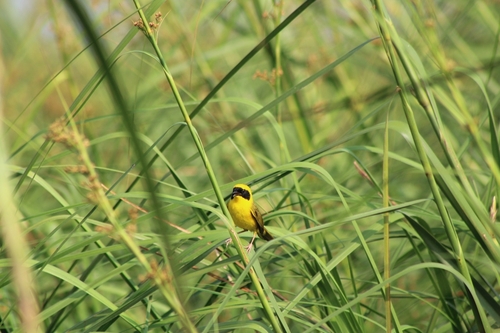 Altamira YellowthroatGeothlypis flavovelataThe Altamira yellowthroat is 13 cm (5.1 in) long and has a yellow-green back and bright yellow belly.
 Barbuda WarblerSetophaga subitaThe Barbuda warbler is 12 to 13.5 cm (4.7 to 5.3 in) long and weighs 5.3 to 8 g (0.19 to 0.28 oz).
Learn the Whistling Warbler in the BeakBrain App
Photo and call practice. Coming soon to iPhone and Android.
Play today's Daily BirdEvery photo and recording on this page is credited to its author under the licence shown. Spotted a problem with this page, or have a better photo? Contribute.