Learn what every symbol on the card means.Full credits and sources at beakbrain.com/symbols
 ShrublandTiny · 8 g

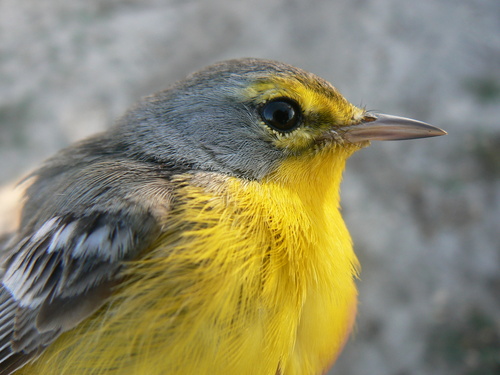
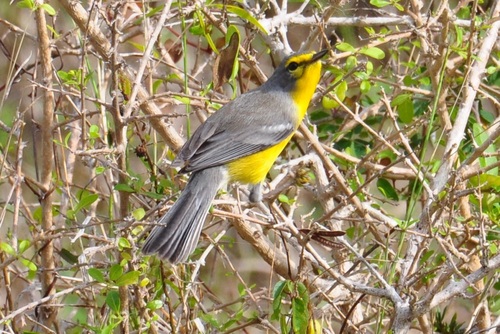
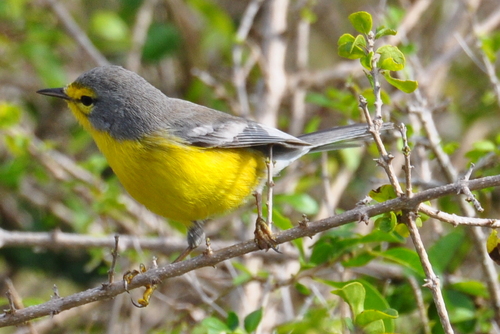
ID tip
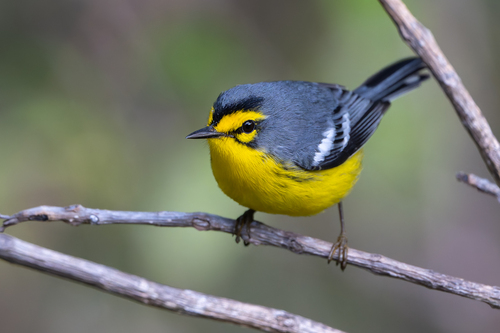
The Barbuda warbler is 12 to 13.5 cm (4.7 to 5.3 in) long and weighs 5.3 to 8 g (0.19 to 0.28 oz). The sexes have the same plumage. Adults have a slightly yellow forehead, a mouse gray crown, dark lores, a wide yellow supercilium to just behind the eye, a yellow arc below the eye, and mouse gray ear coverts. Their back is light gray with a brownish tinge and their rump and uppertail coverts are mouse gray. Their wings are mostly black with thin gray edges on the flight feathers and gray tips on the greater coverts that show as a dusky wing bar. Their tail is black. Voice: As of July 2026 xeno-canto had a single recording of a Barbuda warbler song; the Cornell Lab's Macaulay Library had many. However, no description of the species' vocalizations was available at that time.
Text from Wikipedia, licensed CC BY-SA 4.0.
When to see the Barbuda Warbler
One bar for each month. Filled bars are the 7 months with records; pale bars are months with none. The wide bar is March, the month with the most records.
Where to see the Barbuda Warbler
The map shades 1 country with regular records. Everything unshaded has no records. Countries are listed below the map.
About the Barbuda Warbler
The Barbuda warbler is a species of bird in the family Parulidae. It is endemic to the island of Barbuda in Antigua and Barbuda. Its natural habitat is tropical dry shrubland near wetland areas. It is threatened by habitat loss. It once was considered a subspecies of the Adelaide's warbler. In September 2017, the warbler's habitat was massively damaged by Hurricane Irma. Despite this, the species was found to have survived the storm and its aftermath, and later surveys have indicated that the species was not significantly affected by the hurricane. However, it is still threatened by unplanned housing development, garbage dumping, and poor land-use practices.
Text adapted from Wikipedia, licensed CC BY-SA 4.0.
Easily confused with
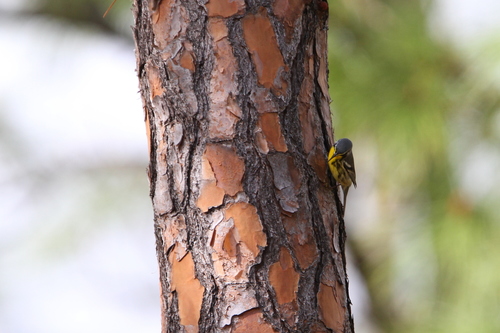 Bahama WarblerSetophaga flavescensThe Bahama warbler is 13 to 14 cm (5.1 to 5.5 in) long and weighs about 10 g (0.35 oz).
 St. Lucia WarblerSetophaga delicataThe St. Lucia warbler is 12.5 cm (4.9 in) long.
 Elfin Woods WarblerSetophaga angelaeThe elfin woods warbler is a small passerine, averaging 12.5 cm (5 in) in length and 8.4 g (0.30 oz) in weight.
Learn the Barbuda Warbler in the BeakBrain App
Photo and call practice. Coming soon to iPhone and Android.
Play today's Daily BirdEvery photo and recording on this page is credited to its author under the licence shown. Spotted a problem with this page, or have a better photo? Contribute.