Learn what every symbol on the card means.Full credits and sources at beakbrain.com/symbols
 ForestCup nestTiny · 9 g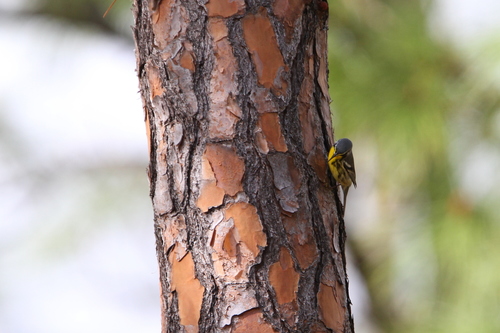




ID tip
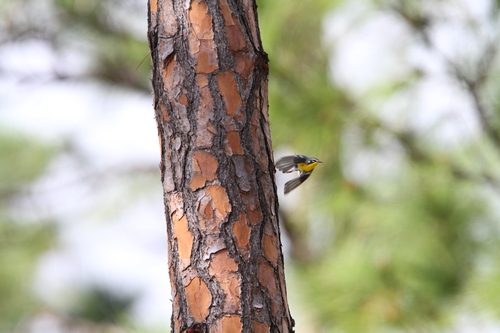
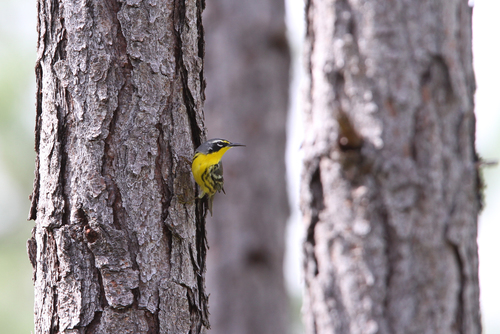
The Bahama warbler is 13 to 14 cm (5.1 to 5.5 in) long and weighs about 10 g (0.35 oz). Adult males have a gray forehead and forecrown, jet black lores and ear coverts, a long bright white supercilium with black streaks above it, a bright yellow spot in front of the eye, and a white arc below the eye. Their hindcrown, nape, and upperparts are grayish with a touch of brown. Their wing's lesser coverts are gray with black centers and their median and greater coverts are dusky gray with black centers and wide white tips that show as two wing bars. Voice: The male Bahama warbler sings "a series of loud, clear whistled notes, with a ringing quality". Compared to the yellow-throated warbler's song, in the Bahama warbler's song is shorter with fewer syllables, the first syllable's highest frequency is lower pitched, most syllables rise in pitch rather than descending, and the final two descend while those of the yellow-throated rise.
Text from Wikipedia, licensed CC BY-SA 4.0.
When to see the Bahama Warbler
One bar for each month. Filled bars are the 10 months with records; pale bars are months with none. The wide bar is January, the month with the most records.
Where to see the Bahama Warbler
The map shades 1 country with regular records. Everything unshaded has no records. Countries are listed below the map.
About the Bahama Warbler
The Bahama warbler is an endangered species of bird in the family Parulidae that is endemic to The Bahamas.
Text adapted from Wikipedia, licensed CC BY-SA 4.0.
Easily confused with
 Barbuda WarblerSetophaga subitaThe Barbuda warbler is 12 to 13.5 cm (4.7 to 5.3 in) long and weighs 5.3 to 8 g (0.19 to 0.28 oz).
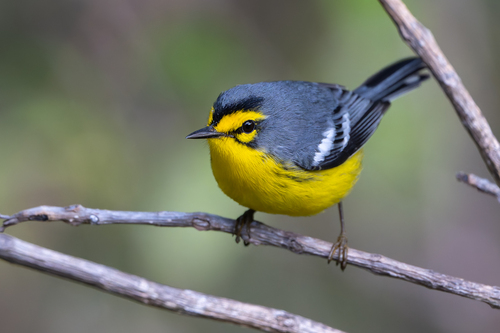 St. Lucia WarblerSetophaga delicataThe St. Lucia warbler is 12.5 cm (4.9 in) long.
 Elfin Woods WarblerSetophaga angelaeThe elfin woods warbler is a small passerine, averaging 12.5 cm (5 in) in length and 8.4 g (0.30 oz) in weight.
Learn the Bahama Warbler in the BeakBrain App
Photo and call practice. Coming soon to iPhone and Android.
Play today's Daily BirdEvery photo and recording on this page is credited to its author under the licence shown. Spotted a problem with this page, or have a better photo? Contribute.