Learn what every symbol on the card means.Full credits and sources at beakbrain.com/symbols
 MarineCavity nestLarge · 1.2 kg




ID tip
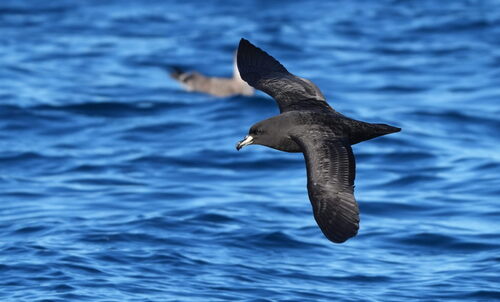
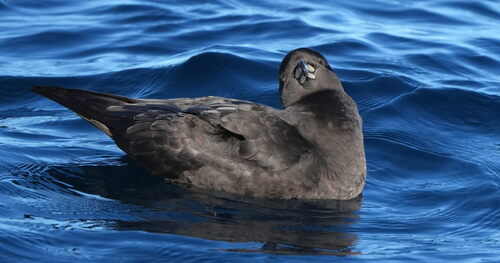
The adult Westland petrel is a stocky bird, weighing around 1,100 grams (39 oz). It is entirely dark blackish-brown, with black legs and feet. Some individuals may have a few white feathers. The bill is pale yellow with a dark tip. Falla measured the female and male birds for his original description and pointed out that the male of the species measured slightly larger than the female. However the female specimen weighed slightly more than the male. It is one of the largest of the burrowing petrels.
Text from Wikipedia, licensed CC BY-SA 4.0.
When to see the Westland Petrel
One bar for each month. Filled bars are the 10 months with records; pale bars are months with none. The wide bar is November, the month with the most records.
Where to see the Westland Petrel
The map shades 4 countries with regular records, and 2 more in a lighter tone where the bird turns up only as a stray. Everything unshaded has no records. Countries are listed below the map.
About the Westland Petrel
The Westland petrel (Procellaria westlandica),, also known as the Westland black petrel, is a moderately large seabird in the petrel family Procellariidae, that is endemic to New Zealand. Described by Robert Falla in 1946, it is a stocky bird weighing approximately 1,100 grams (39 oz), and is one of the largest of the burrowing petrels. It is a dark blackish-brown colour with black legs and feet. It has a pale yellow bill with a dark tip.
Text adapted from Wikipedia, licensed CC BY-SA 4.0.
Easily confused with
 Black PetrelProcellaria parkinsoniThe plumage of the black petrel is all black, as are its legs and bill except for pale sections on the bill.
 Grey PetrelProcellaria cinereaThe grey petrel is a large grey, white, and brown petrel.
 Spectacled PetrelProcellaria conspicillataThe spectacled petrel is a large, approximately 55 cm (22 in) in length, predominately black petrel.
Side by side: Westland Petrel vs White-chinned Petrel · Black Petrel vs Westland Petrel
Learn the Westland Petrel in the BeakBrain App
Photo and call practice. Coming soon to iPhone and Android.
Play today's Daily BirdEvery photo and recording on this page is credited to its author under the licence shown. Spotted a problem with this page, or have a better photo? Contribute.