Learn what every symbol on the card means.Full credits and sources at beakbrain.com/symbols
 ForestTiny · 3 g


ID tip
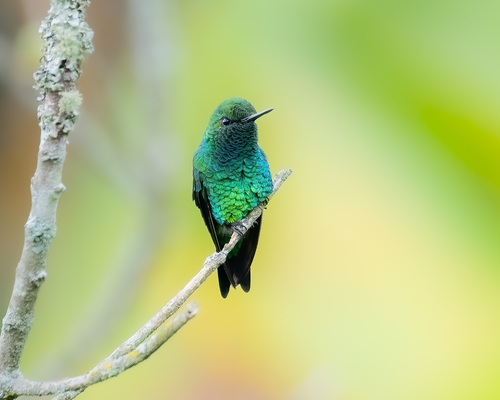
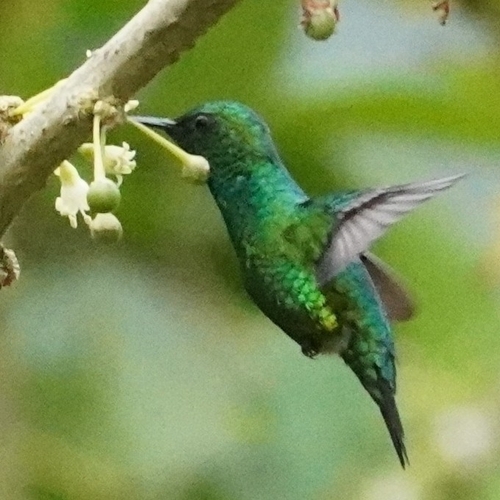
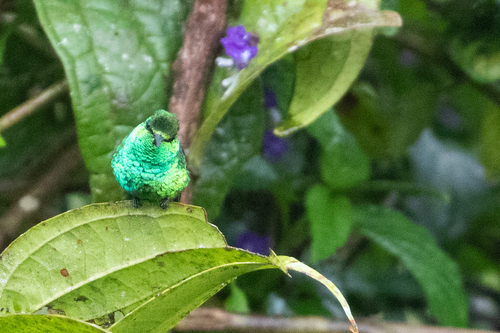
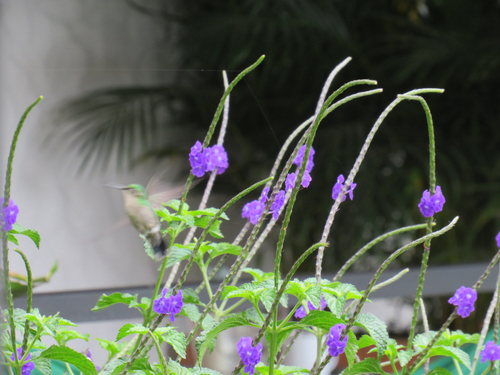
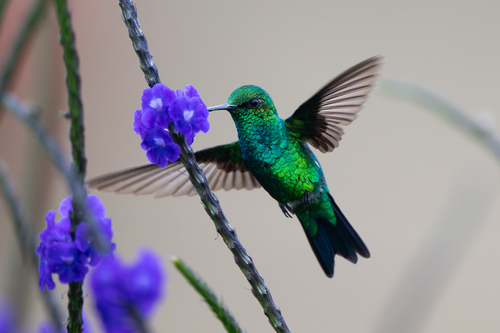
The western emerald is 10.9 to 11.4 cm (4.3 to 4.5 in) long and weighs about 2.6 g (0.092 oz). Both sexes of both subspecies have a short black bill. The nominate male has an iridescent green forehead and crown with gold highlights, a bright green face, shining bronzy green upperparts, and a steel blue tail. Its underparts are glittering emerald green, with greater iridescence and a blue tinge on the breast. It has white thigh tufts. The female has a bronzy green forehead and crown and a blackish face with a pale gray spot behind the eye. Voice: The western emerald's song is "a continuous series of subdued scratchy and wheezy notes... sometimes preceded by a few introductory notes, witsitsitsi...chirr..chirr..chirr..chirr.. or tsit-trr, tsit-trr, tsit-trr, tsit-trr...." Its calls include "a soft tsip, pit, and chwep."
Text from Wikipedia, licensed CC BY-SA 4.0.
When to see the Western Emerald
One bar for each month, and every month is filled: this bird is recorded here in all twelve. The wide bar is November, the month with the most records.
Where to see the Western Emerald
The map shades 2 countries with regular records. Everything unshaded has no records. Countries are listed below the map.
About the Western Emerald
The western emerald is a species of hummingbird in the "emeralds", tribe Trochilini of subfamily Trochilinae. It is found in Colombia and Ecuador.
Text adapted from Wikipedia, licensed CC BY-SA 4.0.
Easily confused with
 Blue-tailed EmeraldChlorostilbon mellisugusMale blue-tailed emeralds are 7.5 to 9.5 cm (3.0 to 3.7 in) long and females 6.5 to 7.5 cm (2.6 to 3.0 in).
 Garden EmeraldChlorostilbon assimilisThe garden emerald is 7.8 to 8.5 cm (3.1 to 3.3 in) long and weighs about 3 to 4.1 g (0.11 to 0.14 oz).
 Red-billed EmeraldChlorostilbon gibsoniThe red-billed emerald is 7.6 to 9 cm (3.0 to 3.5 in) long and weighs about 2.8 g (0.099 oz).
Side by side: Glittering-bellied Emerald vs Western Emerald · Blue-tailed Emerald vs Western Emerald · Garden Emerald vs Western Emerald · Red-billed Emerald vs Western Emerald
Learn the Western Emerald in the BeakBrain App
Photo and call practice. Coming soon to iPhone and Android.
Play today's Daily BirdEvery photo and recording on this page is credited to its author under the licence shown. Spotted a problem with this page, or have a better photo? Contribute.