Learn what every symbol on the card means.Full credits and sources at beakbrain.com/symbols
 ForestCup nestTiny · 3 g


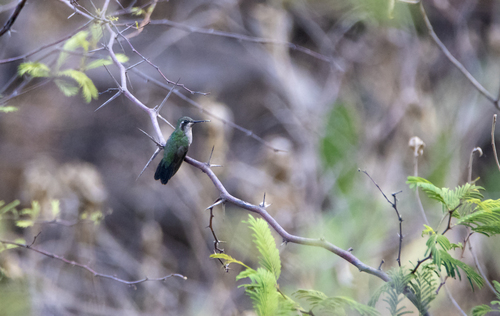
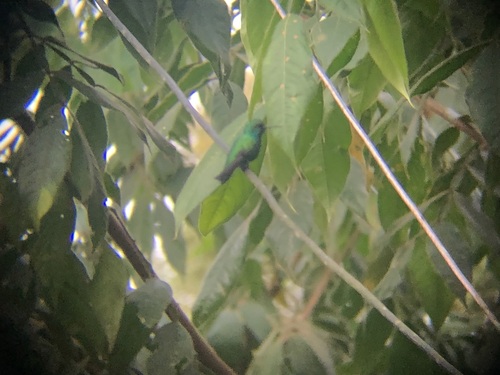
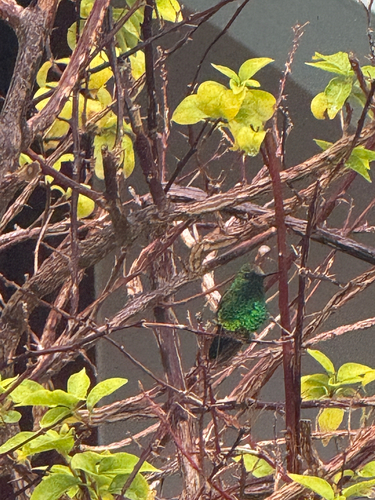
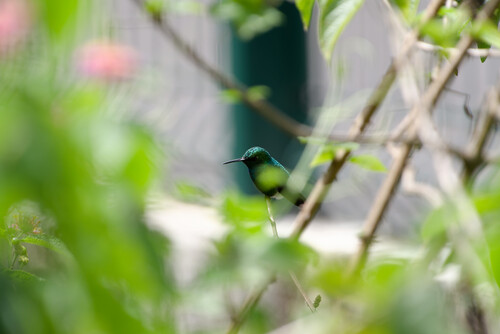
ID tip
Male blue-tailed emeralds are 7.5 to 9.5 cm (3.0 to 3.7 in) long and females 6.5 to 7.5 cm (2.6 to 3.0 in). Males of C. m. caribaeus average about 2.7 g (0.095 oz) and females about 2.5 g (0.088 oz). Males of C. m. phoeopygus average about 2.7 g (0.095 oz) and females about 2.4 g (0.085 oz). Both sexes of all subspecies have a short, straight, black bill. All of the males have a forked tail whose depth varies somewhat among the subspecies. Females are essentially indistinguisable from each other. Voice: The blue-tailed emerald's song has been described as "repeated 'tsip' or chwep notes, with occasional rolls or twitters". Its calls include "a relatively loud and harsh chirrrt and "soft 'tsip', 'pit' and 'chwep'" notes.
Text from Wikipedia, licensed CC BY-SA 4.0.
When to see the Blue-tailed Emerald
One bar for each month, and every month is filled: this bird is recorded here in all twelve. The wide bar is May, the month with the most records.
Where to see the Blue-tailed Emerald
The map shades 13 countries with regular records. Everything unshaded has no records. Countries are listed below the map.
About the Blue-tailed Emerald
The blue-tailed emerald is a hummingbird in the "emeralds", tribe Trochilini of subfamily Trochilinae. It is found in tropical and subtropical South America east of the Andes from Colombia east to the Guianas and Trinidad, and south to northern Bolivia and central Brazil.
Text adapted from Wikipedia, licensed CC BY-SA 4.0.
Easily confused with
 Garden EmeraldChlorostilbon assimilisThe garden emerald is 7.8 to 8.5 cm (3.1 to 3.3 in) long and weighs about 3 to 4.1 g (0.11 to 0.14 oz).
 Western EmeraldChlorostilbon melanorhynchusThe western emerald is 10.9 to 11.4 cm (4.3 to 4.5 in) long and weighs about 2.6 g (0.092 oz).
 Red-billed EmeraldChlorostilbon gibsoniThe red-billed emerald is 7.6 to 9 cm (3.0 to 3.5 in) long and weighs about 2.8 g (0.099 oz).
Side by side: Blue-tailed Emerald vs Glittering-bellied Emerald · Blue-tailed Emerald vs Western Emerald · Blue-tailed Emerald vs Garden Emerald · Blue-tailed Emerald vs Red-billed Emerald
Learn the Blue-tailed Emerald in the BeakBrain App
Photo and call practice. Coming soon to iPhone and Android.
Play today's Daily BirdEvery photo and recording on this page is credited to its author under the licence shown. Spotted a problem with this page, or have a better photo? Contribute.