Learn what every symbol on the card means.Full credits and sources at beakbrain.com/symbols
 WetlandScrapeMedium · 108 g


ID tip
The wandering tattler was formally described in 1789 by the German naturalist Johann Friedrich Gmelin in his revised and expanded edition of Carl Linnaeus's Systema Naturae. He placed it in the genus Scolopax and coined the binomial name Scolopax incana. Gmelin based his description on the "ash-coloured snipe" that had been described in 1785 by the English ornithologist John Latham in his book A General Synopsis of Birds. Latham's specimen had been supplied by the naturalist Joseph Banks.
Text from Wikipedia, licensed CC BY-SA 4.0.
When to see the Wandering Tattler
One bar for each month, and every month is filled: this bird is recorded here in all twelve. The wide bar is September, the month with the most records.
Where to see the Wandering Tattler
The map shades 38 countries with regular records, and 3 more in a lighter tone where the bird turns up only as a stray. Everything unshaded has no records. Countries are listed below the map.
About the Wandering Tattler
The wandering tattler is a medium-sized shorebird, similar in appearance to the closely related gray-tailed tattler. The tattlers are unique among the species of Tringa for having unpatterned, greyish wings and backs, and a scaly breast pattern extending more or less onto the belly in breeding plumage, in which both also have a rather prominent supercilium.
Text adapted from Wikipedia, licensed CC BY-SA 4.0.
Easily confused with
 Grey-tailed TattlerTringa brevipesThe grey-tailed tattler is closely related to its North American counterpart, the wandering tattler (T. incana) and is difficult to distinguish from that species.
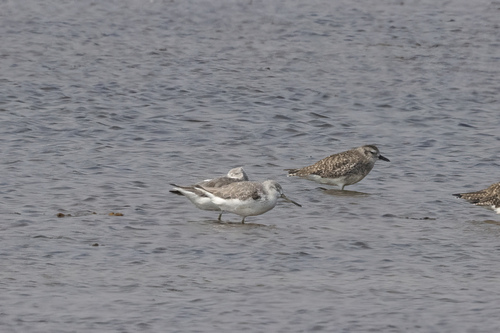 Nordmann's GreenshankTringa guttiferNordmann's greenshank is a medium-sized sandpiper, at 29–32 cm (11–13 in) long, with a slightly upturned, bicoloured bill, and relatively short yellow legs.
 Marsh SandpiperTringa stagnatilisThe marsh sandpiper resembles a small elegant greenshank, with a long fine bill and very long yellowish legs.
Side by side: Spotted Redshank vs Wandering Tattler · Marsh Sandpiper vs Wandering Tattler · Jack Snipe vs Wandering Tattler · Grey-tailed Tattler vs Wandering Tattler · Nordmann's Greenshank vs Wandering Tattler
Learn the Wandering Tattler in the BeakBrain App
Photo and call practice. Coming soon to iPhone and Android.
Play today's Daily BirdEvery photo and recording on this page is credited to its author under the licence shown. Spotted a problem with this page, or have a better photo? Contribute.