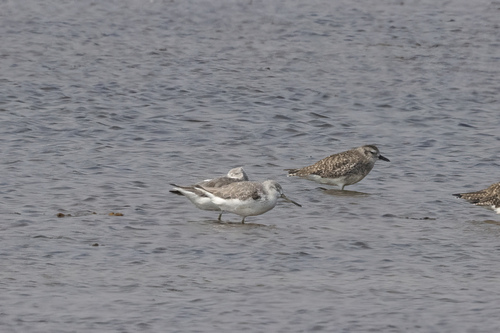
Nordmann's Greenshank
Tringa guttifer
Nordmann's greenshank is a medium-sized sandpiper, at 29–32 cm (11–13 in) long, with a slightly upturned, bicoloured bill, and relatively short yellow legs. Breeding adults have darker plumage than their non-breeding counterparts. These adults often appear boldly marked, with dark brown spangling on their back, chest, and head and a white underbelly.They have a heavily streaked head and upper neck; broad, blackish, crescentic spots on lower neck and breast; and darker lores. Breeding adult bills are darker and less obviously bicolored as well.
ID text from Wikipedia, CC BY-SA 4.0

Wandering Tattler
Tringa incana
The wandering tattler was formally described in 1789 by the German naturalist Johann Friedrich Gmelin in his revised and expanded edition of Carl Linnaeus's Systema Naturae. He placed it in the genus Scolopax and coined the binomial name Scolopax incana. Gmelin based his description on the "ash-coloured snipe" that had been described in 1785 by the English ornithologist John Latham in his book A General Synopsis of Birds. Latham's specimen had been supplied by the naturalist Joseph Banks.
ID text from Wikipedia, CC BY-SA 4.0
Where you might meet both
Learn this pair in the BeakBrain App
Photo and call practice. Coming soon to iPhone and Android.
Play today's Daily BirdPhotos and recordings are credited to their authors under the licence shown. Full profiles: Nordmann's Greenshank and Wandering Tattler.