Learn what every symbol on the card means.Full credits and sources at beakbrain.com/symbols
 WetlandPlatform nestMedium · 84 g


What the Virginia Rail sounds like


ID tip
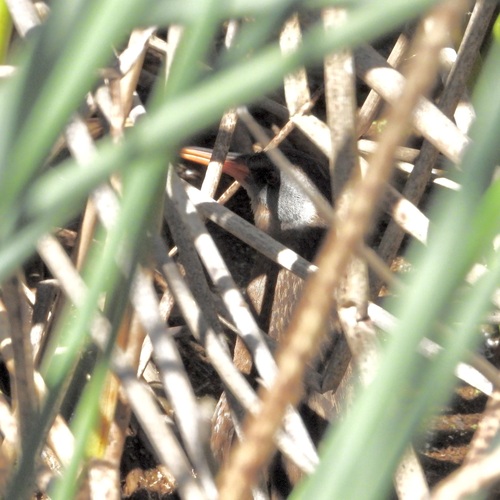
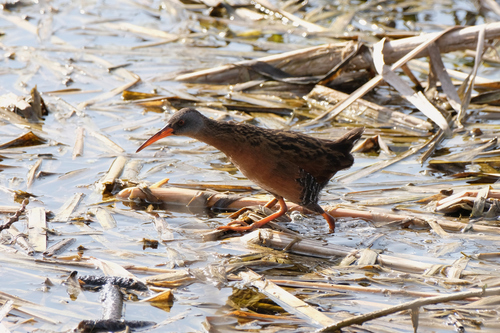
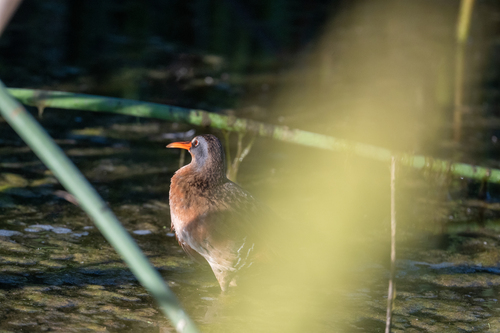
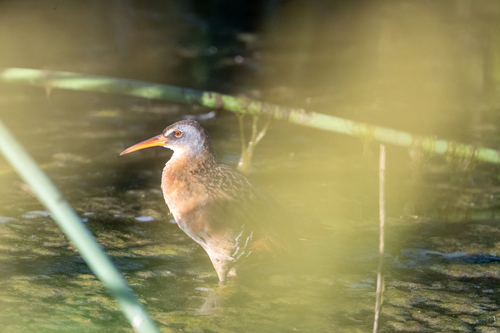
Adults are mainly brown, darker on the back and crown, with orange-brown legs. To walk through dense vegetation, they have evolved a laterally compressed body and strong forehead feathers adapted to withstand wear from pushing through vegetation. Virginia rails have the highest ratio of leg-muscle to flight-muscle of all birds (25% - 15% of body weight respectively). They have long toes used to walk on floating vegetation. Their tail is short and they have a long slim reddish bill. Their cheeks are grey, with a light stripe over the eye and a whitish throat. Chicks are black. Voice: This bird has a number of calls, including a harsh kuk kuk kuk, usually heard at night. It also makes grunting noises. In spring, it will make tick-it or kid-ick calls.
Text from Wikipedia, licensed CC BY-SA 4.0.
When to see the Virginia Rail
One bar for each month. Filled bars are the 11 months with records; pale bars are months with none. The wide bar is May, the month with the most records.
Where to see the Virginia Rail
The map shades 4 countries with regular records, and 3 more in a lighter tone where the bird turns up only as a stray. Everything unshaded has no records. Countries are listed below the map.
Recorded as a rare visitor in Bahamas, Colombia, St. Pierre & Miquelon.
About the Virginia Rail
The Virginia rail is a small waterbird, of the family Rallidae. These birds remain fairly common despite continuing loss of habitat, but are secretive by nature and more often heard than seen. They are also considered a game species in some provinces and states, though rarely hunted. The Ecuadorian rail is often considered a subspecies, but some taxonomic authorities consider it distinct.
Text adapted from Wikipedia, licensed CC BY-SA 4.0.
Easily confused with
 Water RailRallus aquaticusThe adult of the nominate subspecies is a medium-sized rail, 23–28 cm (9.1–11.0 in) long with a 38–45 cm (15–18 in) wingspan.
 Clapper RailRallus crepitansThe clapper rail is a chicken-sized bird that rarely flies.
 King RailRallus elegansDistinct features are a long bill with a slight downward curve, with adults being brown on the back and rusty-brown on the face and breast with a dark brown cap.
Side by side: Virginia Rail vs Water Rail · Clapper Rail vs Virginia Rail · King Rail vs Virginia Rail
Learn the Virginia Rail in the BeakBrain App
Photo and call practice. Coming soon to iPhone and Android.
Play today's Daily BirdEvery photo and recording on this page is credited to its author under the licence shown. Spotted a problem with this page, or have a better photo? Contribute.