Learn what every symbol on the card means.Full credits and sources at beakbrain.com/symbols
 WetlandPlatform nestLarge · 313 g


What the King Rail sounds like

ID tip
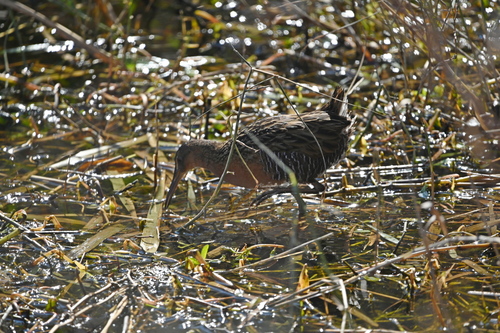
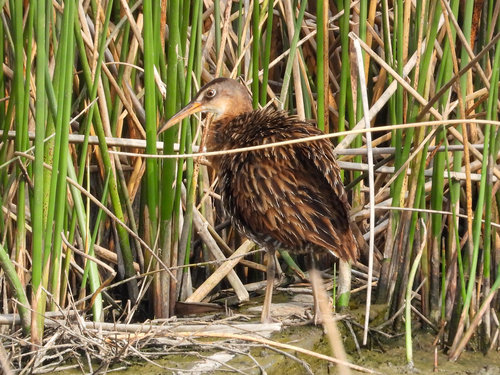
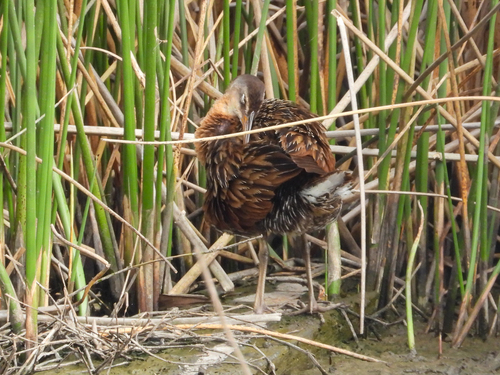
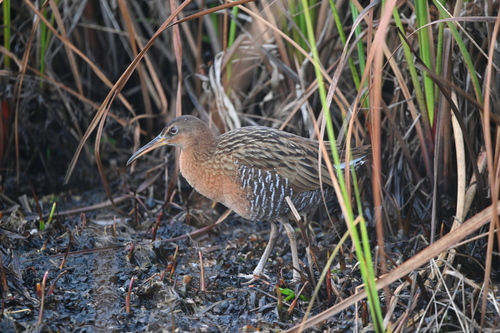
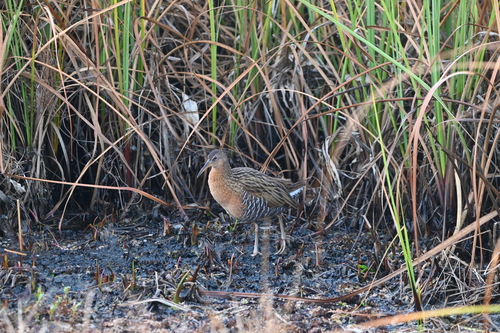
Distinct features are a long bill with a slight downward curve, with adults being brown on the back and rusty-brown on the face and breast with a dark brown cap. They also have a white throat and a light belly with barred flanks. Undertail coverts are white and are displayed by the male during courtship. Immature birds are covered in down, with light brown on the head and darker brown on the back and wings. This bird's call is a low repeated grunt transcribed as kek-kek-kek.
Text from Wikipedia, licensed CC BY-SA 4.0.
When to see the King Rail
One bar for each month. Filled bars are the 11 months with records; pale bars are months with none. The wide bar is April, the month with the most records.
Where to see the King Rail
The map shades 2 countries with regular records, and 2 more in a lighter tone where the bird turns up only as a stray. Everything unshaded has no records. Countries are listed below the map.
About the King Rail
The king rail is a waterbird, the largest North American rail.
Text adapted from Wikipedia, licensed CC BY-SA 4.0.
Easily confused with
 Ridgway's RailRallus obsoletusRidgway's rail is a species of bird found principally along the Pacific coast of North America from the San Francisco Bay Area to southern Baja California, as well as in some regions of the Gulf of California.
 African RailRallus caerulescensAdults are 27–28 cm (10.6–11.0 in) long, and have mainly brown upperparts and blue-grey underparts, with black-and-white barring on the flanks and undertail.
 Brown-cheeked RailRallus indicusThe species differs from the slightly smaller nominate form through its paler upperparts, brown-tinged underparts and a brown stripe through the eye.
Side by side: King Rail vs Water Rail · King Rail vs Virginia Rail · Clapper Rail vs King Rail · African Rail vs King Rail · Brown-cheeked Rail vs King Rail
Learn the King Rail in the BeakBrain App
Photo and call practice. Coming soon to iPhone and Android.
Play today's Daily BirdEvery photo and recording on this page is credited to its author under the licence shown. Spotted a problem with this page, or have a better photo? Contribute.