Learn what every symbol on the card means.Full credits and sources at beakbrain.com/symbols
 ShrublandTiny · 13 g
ID tip
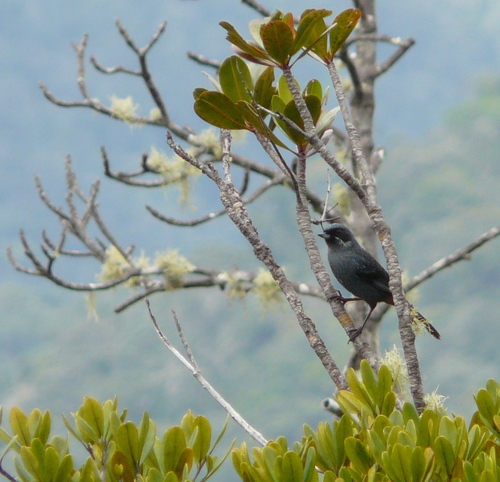
The Venezuelan flowerpiercer is, on average, 12.7 cm (5.0 in) long. Males are almost wholly dull black, with small white patches on the pectorals at the edge of the wing and some white on the underside of the wing. Females have brownish-olive upper bodies with yellowish-olive heads, yellowish-olive throats and breasts, and gray to brown-olive on the rest of the belly. The pectorals and underside of the wing have white patches. The upper mandible of the beak ends in a sharp, downcurving hook.
Text from Wikipedia, licensed CC BY-SA 4.0.
When to see the Venezuelan Flowerpiercer
One bar for each month. Filled bars are the 7 months with records; pale bars are months with none. The wide bar is March, the month with the most records.
Where to see the Venezuelan Flowerpiercer
The map shades 1 country with regular records. Everything unshaded has no records. Countries are listed below the map.
About the Venezuelan Flowerpiercer
The Venezuelan flowerpiercer is a species of bird in the family Thraupidae. It is endemic to Venezuela. Its natural habitat is subtropical or tropical moist montane forests in the north of Venezuela. It is threatened by habitat loss. Protected areas where it is resident include the Cueva del Guácharo National Park.
Text adapted from Wikipedia, licensed CC BY-SA 4.0.
Easily confused with
 Greater FlowerpiercerDiglossa majorThe greater flowerpiercer grows to a length of about 16.5 cm (6.5 in) and is larger than any other species in the genus.
 Merida FlowerpiercerDiglossa gloriosaThe Mérida flowerpiercer is a species of bird in the family Thraupidae.
Learn the Venezuelan Flowerpiercer in the BeakBrain App
Photo and call practice. Coming soon to iPhone and Android.
Play today's Daily BirdEvery photo and recording on this page is credited to its author under the licence shown. Spotted a problem with this page, or have a better photo? Contribute.