Learn what every symbol on the card means.Full credits and sources at beakbrain.com/symbols
 ForestCup nestSmall · 22 g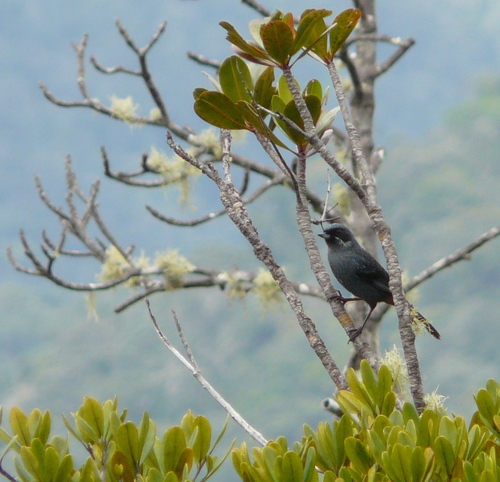

ID tip
The greater flowerpiercer grows to a length of about 16.5 cm (6.5 in) and is larger than any other species in the genus. The adult has a black mask but is otherwise a bluish-slate colour, with a silvery moustachial streak and silvery streaks on the crown and mantle. It has a chestnut crissum (the area around the cloaca). It is unlikely to be confused with related species because no other members of the genus share its range.
Text from Wikipedia, licensed CC BY-SA 4.0.
When to see the Greater Flowerpiercer
One bar for each month. Filled bars are the 9 months with records; pale bars are months with none. The wide bar is February, the month with the most records.
Where to see the Greater Flowerpiercer
The map shades 2 countries with regular records, and 1 more in a lighter tone where the bird turns up only as a stray. Everything unshaded has no records. Countries are listed below the map.
Recorded as a rare visitor in Brazil.
About the Greater Flowerpiercer
The greater flowerpiercer is a species of bird in the family Thraupidae. It is found in the tepuis of western Guyana, eastern Venezuela, and far northern Brazil. Its natural habitats are subtropical or tropical moist montane forests and subtropical or tropical high-altitude shrubland.
Text adapted from Wikipedia, licensed CC BY-SA 4.0.
Easily confused with
 Merida FlowerpiercerDiglossa gloriosaThe Mérida flowerpiercer is a species of bird in the family Thraupidae.
Venezuelan FlowerpiercerDiglossa venezuelensisThe Venezuelan flowerpiercer is, on average, 12.7 cm (5.0 in) long.
Scaled FlowerpiercerDiglossa duidaeThe scaled flowerpiercer is a species of bird in the family Thraupidae.
Merida FlowerpiercerDiglossa gloriosaThe Mérida flowerpiercer is a species of bird in the family Thraupidae.
Venezuelan FlowerpiercerDiglossa venezuelensisThe Venezuelan flowerpiercer is, on average, 12.7 cm (5.0 in) long.
Scaled FlowerpiercerDiglossa duidaeThe scaled flowerpiercer is a species of bird in the family Thraupidae.
Learn the Greater Flowerpiercer in the BeakBrain App
Photo and call practice. Coming soon to iPhone and Android.
Play today's Daily BirdEvery photo and recording on this page is credited to its author under the licence shown. Spotted a problem with this page, or have a better photo? Contribute.